
Strategic Realism and the Myth of the “Single-Shot Military”
Industrial depth, not opening strikes, will decide the outcome of high-intensity war
A recurring claim in recent strategic commentary is that the United States has become a “single-shot military” — capable of fighting one high-intensity war, and then effectively disarmed for a decade. It is a compelling line. It is also an oversimplification that obscures more than it reveals.
There is a core truth embedded in the argument. The war in Ukraine has exposed real constraints in Western industrial capacity — particularly in the production of precision-guided munitions, artillery shells, and air defence interceptors. These are not marginal concerns; they go to the heart of how modern wars are fought and sustained. Acknowledging them is not alarmism. Treating them as the whole story is.
The “single-shot” framing collapses two analytically distinct problems into one rhetorical package: industrial friction and systemic collapse. The former is real, documented, and demands serious policy attention. The latter is a speculative leap — and a consequential one, because the conclusions drawn from it tend to shape both deterrence posture and adversary calculation.
The question is not whether the U.S. can fight. It is whether it can endure — and whether its adversaries can endure longer.
Iran is not an easy adversary — but endurance cuts both ways
Any serious analysis of a U.S.-Iran scenario must begin by acknowledging what Iran has actually built. It has spent four decades preparing for asymmetric warfare against a technologically superior opponent. Its doctrine is not organised around conventional parity but around attrition, disruption, and escalation management — ballistic missiles, drone swarms, proxy networks, and layered denial strategies across the Gulf and the Strait of Hormuz. Any serious conflict would be costly, chaotic, and far from the clean, decisive campaigns that tend to populate public discourse.
But asymmetric capability does not equal infinite resilience. Iran operates under severe sanctions, with a constrained and increasingly fragile economic base. Its defence industrial sector, while more capable than often credited, faces chronic shortages of precision components, advanced electronics, and foreign exchange. Its ability to sustain high-intensity operations over weeks — let alone months — is not unlimited.
The “single-shot” framing inadvertently flatters Iran by implying that a single intense exchange would exhaust American capacity while leaving Iran’s substantially intact. The actual picture is more symmetrical, and more uncomfortable for both sides: a prolonged conflict would impose severe attrition on each. The question is not who runs out first in the abstract — it is whose production curve bends upward faster under wartime conditions.
What industrial depth actually means
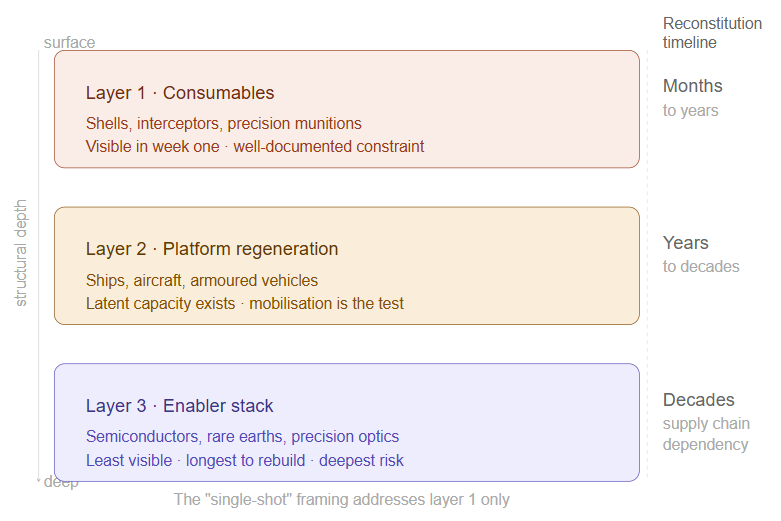
To move beyond rhetoric, the conversation needs a more precise analytical vocabulary. “Industrial depth” is not a single variable — it is a cluster of distinct capacities, each with its own production timeline, supply chain vulnerability, and reconstitution logic. Conflating them produces the same error as the “single-shot” framing itself: a vivid phrase substituting for structural analysis.
The most immediate constraint is in consumables: 155mm artillery shells, Stinger and Patriot interceptors, Javelin anti-tank systems, and the components that feed precision strike. The Ukraine conflict burned through NATO stockpiles at rates that peacetime industrial planning had not anticipated. Replenishment timelines — measured in years for some systems — are a genuine operational constraint. This is the part of the “single-shot” argument that deserves to be taken seriously.
The second layer is platform regeneration: the ability to replace ships, aircraft, and armoured vehicles lost in combat. Here the picture is more complex. The United States maintains a shipbuilding and aerospace industrial base that, while slower and more expensive than during the Cold War, retains significant latent capacity. The question is not whether it exists but whether it can be mobilised at pace — a question of procurement law, contractor incentive structures, and political will as much as physical capacity.
The third and least-discussed layer is the enabler stack: the semiconductors, rare earth elements, precision optics, and software systems that underpin modern military performance. This is where the deepest structural vulnerabilities lie — not in munitions production rates, but in the supply chains for the components that make precision munitions precise. A conflict that disrupted Taiwan Strait shipping lanes would simultaneously stress both sides of a U.S.-China confrontation in ways that the “single-shot” framing does not capture.
Industrial depth is not a single variable. It is a cluster of distinct capacities — consumables, platform regeneration, and the enabler stack — each with its own vulnerability and reconstitution logic.
Endurance is political before it is industrial
Even granting the industrial constraints, the “single-shot” framing makes a further error: it treats military capacity as the binding constraint on endurance, when history suggests the binding constraint is usually political.
The United States did not lose in Vietnam because it ran out of munitions. It did not withdraw from Afghanistan because its industrial base was exhausted. In both cases, the collapse was in political will — the domestic capacity to sustain the costs of conflict in lives, treasure, and attention over time. Industrial regeneration is possible; political regeneration, once lost, is far harder.
This cuts in both directions. A high-intensity conflict with Iran — or any near-peer adversary — would impose costs that democratic societies find difficult to absorb over time. But it also means that the “single-shot” framing, by focusing exclusively on hardware, misses the more consequential variable. An adversary that can outlast American political will does not need to match American industrial capacity. It needs to survive long enough for domestic opposition to do the work.
Conversely, if the political conditions for sustained conflict exist — as they arguably did after September 2001, at least initially — American industrial capacity has historically proven more elastic than peacetime baselines suggest. The question of endurance is therefore not primarily answered by counting shell stocks. It is answered by understanding the political economy of conflict — who bears the costs, how they are distributed, and whether the narrative sustaining the conflict remains coherent over time.
What the framing gets right, and what it gets wrong
The “single-shot military” argument performs a useful function: it forces a conversation about industrial capacity that official discourse tends to defer. Defence establishments are institutionally incentivised to project capability and minimise acknowledgment of constraint. Commentary that punctures that tendency serves an important corrective purpose.
Where it goes wrong is in the leap from documented friction to systemic collapse — and in the implicit assumption that adversaries are immune to the same dynamics. The United States faces real industrial bottlenecks. So does every other military power operating at sustained high intensity. The relevant question is comparative: who manages those bottlenecks better, under what conditions, and over what time horizon.
That is a harder question than “can the U.S. fight twice?” It requires examining supply chain resilience, allied industrial integration, the depth of the defence technology base, and the political conditions under which conflict would be sustained. None of these admit simple answers. But they are the right questions — and the ones that should replace the single-shot framing in serious strategic analysis.
Conclusion
The single-shot framing has done its job: it has inserted industrial capacity into a strategic conversation that too often fixates on doctrine, platforms, and order of battle. That is a genuine contribution.
But a corrective that overcorrects is not an analysis — it is a different kind of simplification. The United States has real industrial constraints. So does every other actor in a high-intensity conflict. The decisive variable is not who exhausts first in the opening phase; it is whose industrial, political, and alliance architecture proves more durable over the full duration of a conflict neither side planned for.
Answering that question requires moving past vivid phrases and into the structural variables that actually govern wartime endurance: production elasticity, supply chain depth, political will, and the industrial integration of alliances. These are less quotable than “single-shot military.” They are also closer to the truth.
Follow on X: The Quiet Cartographer