
You're Reading the Wrong Document
The strategy everyone is analysing is not the one shaping U.S. behaviour
On the evening of December 4, 2025, the White House released its National Security Strategy. There was no presidential address. No press conference. No national security advisor standing at a podium to explain what had changed and why. The document appeared without ceremony, as if it were an internal memo that had been accidentally made public. Analysts noted the compressed rollout. Most kept reading the document anyway.
That instinct — to read the strategy document as the place where American foreign policy is decided — is understandable. Strategy documents are written to be read as plans. The problem is that in this case, reading it that way means starting at the wrong end.
The 2025 National Security Strategy is not the origin of the current American posture. It is a surface. What produced that surface — what shaped the range of outcomes it could plausibly describe — is a document most analysts treat as a domestic political artefact rather than a foreign policy input: Project 2025, formally titled Mandate for Leadership: The Conservative Promise, produced by the Heritage Foundation. This is not just conceptual alignment. Project 2025 was built as a governing blueprint, with its authors and policy leads forming a personnel pipeline into executive branch roles, collapsing the distance between institutional design and strategic output.
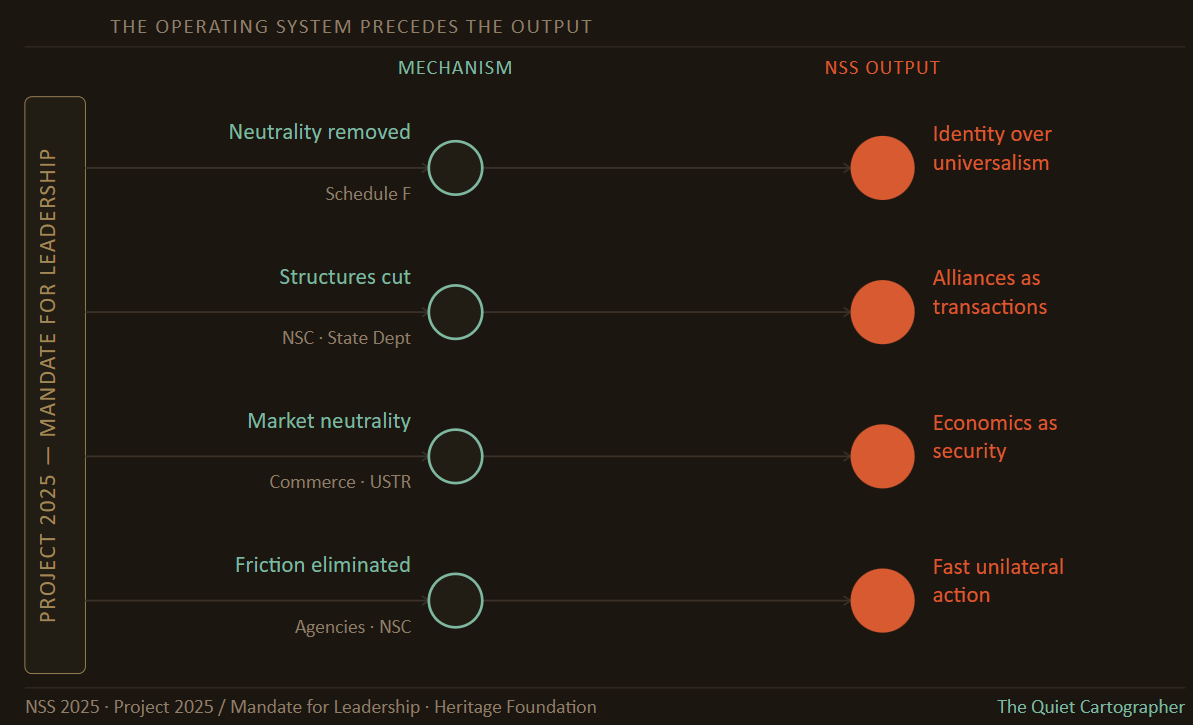
These two documents do not sit at the same layer. Project 2025 operates at the level of structure. The National Security Strategy operates at the level of expression. One configures the state. The other describes how that configured state behaves when it turns outward.
The machine was built first. The message followed.
This shift in sequencing changes what analysis is for. If the strategy document is treated as the starting point, every question remains downstream. Coherence, feasibility, and alignment between stated goals and observed behaviour all assume the document meaningfully constrains action. It is evaluated as a plan rather than recognised as a record of a pre-shaped set of possibilities.
The upstream question is different. It is not what the United States says it intends to do. It is what the United States has configured itself to make difficult not to do.
From Rules-Based Order to Civilizational State Logic
The core of Project 2025 is not policy preference. It is institutional design.
The document — nearly 900 pages, co-authored by former administration officials including Russell Vought, who now directs the Office of Management and Budget — specifies how the executive branch should be staffed, restructured, and controlled. It concentrates authority, redirects agencies, and reduces decisional friction. Its most consequential mechanism, Schedule F, reclassifies large portions of the career federal bureaucracy as politically removable. The premise is explicit. The professional state is not neutral. It must be aligned.
That mechanism matters because it changes how decisions survive contact with the system. A bureaucracy that can be politically realigned offers less internal resistance, produces greater coherence, and translates executive intent into action with fewer delays or revisions. This is not a policy outcome. It is a change in how outcomes are generated.
That internal shift carries an external consequence. A state that removes institutional neutrality from within cannot credibly present itself as the steward of a universal order. The condition that made universalism legible has been dismantled. What appears in the 2025 strategy as civilisational language and hemispheric assertion, including a renewed emphasis on the Monroe Doctrine, to cover Greenland and the Panama Canal alongside Cuba and Venezuela, is not a foreign policy pivot. It is the external expression of an internal premise.
Remove neutrality from the state, and universalism disappears from its foreign posture.
The same pattern repeats across the document.
From Alliances to Adjustable Arrangements
Project 2025 treats permanent institutions with systematic suspicion. Structures that operate outside direct presidential control are framed as constraints rather than assets. The preference is for controllable, reversible arrangements over permanent institutional commitments.
The 2025 strategy document reflects that logic precisely. Alliances are treated as adjustable relationships, calibrated through burden-sharing calculations and subject to revision when partners fail to contribute. The document is more openly critical of European allies than of declared adversaries — a feature noted by Senior Fellow for U.S. Foreign Policy, Rebecca Lissner in her reading. That asymmetry is not incidental.
A state reorganised against internal permanent structures will not treat external permanent structures differently. The alliance posture follows from the institutional architecture.
This becomes visible in its hemispheric framing. The Western Hemisphere is treated less as a region to be engaged and more as a domain of control, with emphasis on nearby states and critical infrastructure. This is not foreign policy innovation. It is projection. A state that has repositioned itself as a principal internally expresses that position externally.
Economic Security as National Security
The absorption of economics into security follows the same trajectory.
The post-war system maintained a working separation between economic governance and national security. That separation encoded an assumption that markets operated with some independence from state control, and that economic integration produced benefits that outlasted any individual administration’s preferences.
Project 2025 removes that assumption. Its proposals for the Department of Commerce, the Office of the United States Trade Representative, and financial regulatory bodies bring economic institutions under tighter executive direction and reorient them toward national interest calculations. Trade, industry, and finance become instruments of state power.
The strategy document does not construct this shift. It reflects it. Supply chains, industrial capacity, financial systems, and energy appear as strategic domains because the institutions governing them have already been redefined.
The document does not fuse economics and security. It describes a state in which that fusion has already occurred.
Executive Centralization and the Speed of Action
The final signal is procedural.
The compressed release of the strategy document was not a communications failure. It reflects a system designed to reduce internal friction. Project 2025 targets the mechanisms through which interagency processes and institutional review slow or reshape executive intent. When those constraints are reduced, decisions move faster and appear with less visible negotiation.
The document carries that signature. It is faster, more direct, and less layered than its predecessors. These are not stylistic choices. They are properties of the system that produced it.
What This Means for Analysis
Taking structure as the starting point changes both the documents and the questions that matter. Analysis moves upstream, to where the space of possible action is defined before it is described.
At that level, the National Security Strategy stops looking like a choice. It becomes a record of convergence between capability and declaration, the point at which what the system can do and what it says it will do align closely enough to be written as one.
A different administration can rewrite a strategy document. It cannot quickly unwind a structural configuration embedded across agencies, personnel systems, and decision processes.
The machine is built first. The message follows.
Once the structure is visible, the strategy stops looking like a decision. It becomes a description of the path the system is already prepared to take.
That is the document worth reading.
Follow on X: The Quiet Cartographer
Sources and additional reading
Brookings Institution — Breaking Down the 2025 National Security Strategy
Council on Foreign Relations — Unpacking the 2025 National Security Strategy
FPRI — The New US National Security Strategy: A Transactional Document that Marginalizes Africa
University of Portsmouth — How Project 2025 Became the Blueprint
A close friend of mine alerted me to Project 2025 not long after it was published in 2023, back then I had no idea the role it would come to play…