
The Nuclear Umbrella for Rent
Defence commitments are multiplying faster than the capacity to honour them. They show what security looks like when no single power calls all the shots.
Kuwait wants Pakistani troops on the ground, fighter jets, drones, and an air defence system — the same order of commitment Islamabad has already extended to Saudi Arabia. Reuters reports the ask is substantial enough that Pakistani officials describe it as Kuwait wanting “everything.” Bahrain is exploring something similar. Jordan wants weapons and training. Turkiye, Pakistan, and Saudi Arabia are separately drafting a trilateral pact distinct from any of this.
None of them, together, add up to a single document that obligates Pakistan to show up on every front it has now signalled it might cover.
Individually, each is an ordinary bilateral defence arrangement. Taken together, they resemble a portfolio — a collection of policies written against overlapping risk by one underwriter whose actual reserves have never been tested. That’s the more useful way to read what’s happening across the Gulf right now: not as an alliance system replacing a weakening one, but as an insurance market opening up in the space where a single guarantor’s monopoly used to sit.
The Capital Adequacy
Every insurer needs capital adequate enough to make its promises credible without the reserve ever actually being drawn down. For Pakistan, that capital is nuclear, and it sits outside the normal verification regime entirely — Islamabad has never signed the Non-Proliferation Treaty, and Washington has maintained sustained, deliberate visibility into Pakistan’s custodial security for over two decades, from the post-9/11 Liaison Committee and roughly $100 million in classified US security assistance to what the Washington Post’s black-budget reporting later confirmed was an intelligence effort intense enough to rank Pakistan alongside declared adversaries.
This is the detail that makes the conventional defence pacts legible. Saudi Arabia isn’t paying for Pakistani troops and jets because those assets alone are decisive. It's paying for a signature backed by a balance sheet whose ultimate solvency has never been tested in practice. The nuclear layer barely appears in the paperwork. It doesn’t need to. It’s the capital adequacy that makes everything else Pakistan sells look properly underwritten.
Saudi Arabia isn’t only renting this cover — it’s been quietly working to build its own for decades. The relationship has a documented history: in 1999, Saudi Arabia’s defence minister toured Pakistan’s Kahuta enrichment facility and was shown mock-ups of Pakistani nuclear weapons, a visit that drew a formal US diplomatic protest at the time. That history is no longer just history. CNN reported this week that a draft US-Saudi civil nuclear accord — negotiated since October 2025 and now awaiting Trump’s signature — would grant Riyadh domestic enrichment rights without the full IAEA safeguards regime. Read against the Pakistan relationship, this isn’t a contradiction. It’s the same actor hedging on two timelines: renting a tested-but-unverified deterrent from Islamabad now, while working to build sovereign capital adequacy of its own for later, so that eventually it doesn’t need the rental at all.
This is also where capability and credibility split apart, and the difference matters for reading the rest of this piece. Capability answers whether an actor can act — whether the aircraft can fly, whether the warhead exists. Credibility answers whether other actors change their own behaviour because they believe the actor will act, under conditions nobody has actually observed.
The United States still has more capability in the Gulf than any other power, by a wide margin — carriers, basing, logistics, intelligence. What’s degraded is something else: whether Gulf states are still organising their own hedging decisions around the assumption that the American guarantee is the one that governs outcomes.
Kuwait shopping for Pakistani troops instead of resting on the US security relationship it already has is the evidence for that shift. It isn’t a claim about who has more firepower. It's a claim about whose guarantees Gulf states increasingly choose to incorporate into their own risk calculations.
The Policies Being Written
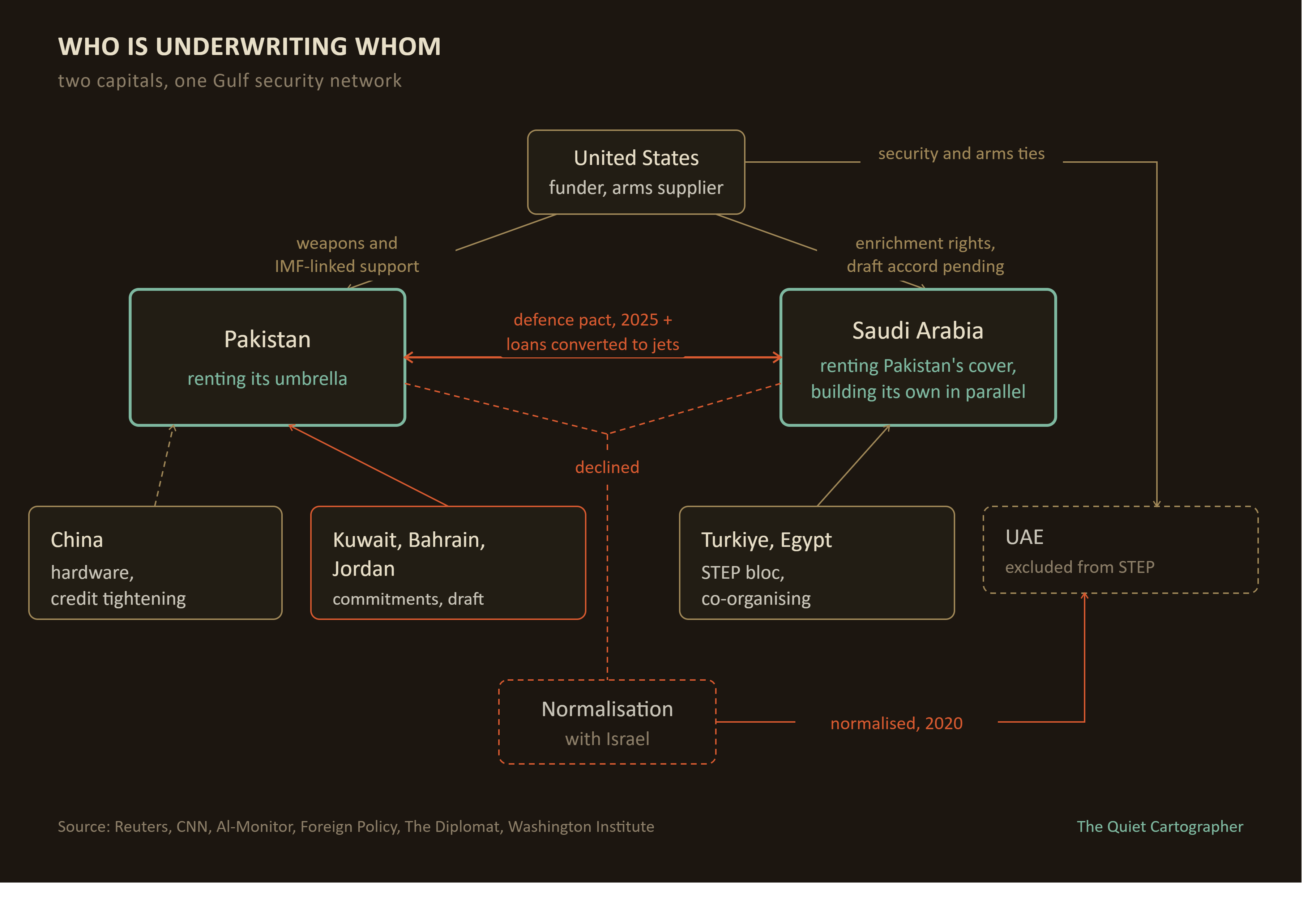
Once those agreements are mapped onto that capital base, the exposure becomes visible. The Strategic Mutual Defence Agreement, signed with Saudi Arabia in September 2025, is the base policy — an Article 5-style commitment treating an attack on either state as an attack on both. Since then, the book has kept growing. Reuters reports Turkiye, Pakistan, and Saudi Arabia have been preparing a separate trilateral draft. Bahrain is weighing a similar arrangement. Jordan wants a narrower training-and-procurement relationship. Kuwait’s ask, still early-stage, is the most demanding underwriting request of the lot.
Each policy was written separately, by a different set of negotiators, on a different timeline, with different exclusions. There is no single master agreement reinsuring the whole book. That means Pakistan can, in principle, be called on across every front simultaneously while being fully bound to none of them — maximum apparent coverage, minimum tested liability. It’s precisely the structure an underwriter would choose if it wanted to sell as many policies as the market would bear without ever having to prove it could pay out on more than one at a time.
The Value Is in the Promise
Here is the part that’s easy to miss if you read this as a story about hardware: Pakistan doesn’t need its umbrella to actually work. It needs enough buyers to believe it might.
That’s not a cynical aside — it’s how this kind of instrument is supposed to function. An insurer’s premium income depends on the perceived odds of a claim, not the claim itself; the entire business model works precisely because most policies never pay out. Strategic ambiguity does the same work for Pakistan that non-disclosure does for an underwriter withholding its actuarial tables. Nobody — not Saudi Arabia, not Kuwait, not Washington — actually knows what Pakistan would do if the deterrent clause were invoked for real, against a nuclear-armed adversary, on someone else’s behalf. That uncertainty isn't a flaw; it is the product itself. Pakistan is not selling security in the way a state sells troops or jets, where delivery is verifiable. It’s selling the market’s collective willingness not to find out.
Reinsurance
Every insurer needs its own backing, and this is where the story stops being about Pakistan’s promises and starts being about who is ultimately financing their credibility — and that reads very differently from the treaty language.
In June, China suspended delivery of the remaining sixteen J-10CE fighters Pakistan had already contracted for — not a new order, an existing one — over unpaid milestone payments Islamabad couldn’t clear against its IMF-constrained reserves. The dispute drew enough attention that Chinese commentators were publicly noting Pakistan hadn’t finished paying for jets it already had while speculation swirled about the far more expensive J-35 stealth fighter.
That J-35 speculation runs into the same constraint. The Diplomat puts the programme near $5–6 billion against a total Pakistani defence budget of roughly $9 billion, with debt servicing alone consuming close to half the federal budget. Beijing extended concessional credit for the JF-17 years ago out of its own strategic necessity. It has considerably less incentive to repeat that now, with Pakistan already behind on existing bills.
Which is what makes the next detail the actual centre of gravity for this whole piece: Reuters reports Pakistan and Saudi Arabia have been in talks to convert roughly $2 billion of existing Saudi loans — loans that helped avert a Pakistani sovereign default — directly into a JF-17 fighter jet deal. Gulf capital extended to keep Pakistan solvent is being restructured into Chinese-origin hardware for the Pakistani air force.
This is the moment the story changes scale. The defence pact headlines describe a security relationship. The financing underneath describes a debt swap that quietly reroutes Chinese military hardware into what has long been reflexively understood as US-aligned security space — funded by Gulf capital, without Washington signing anything, without a single treaty acknowledging that this is what’s actually happening.
Counterparty Risk
An underwriter that accepts every policy is not actually managing risk, it’s accumulating it. Pakistan’s one visible act of risk discipline is instructive precisely because it’s the exception.
Trump said in May that Gulf states, including Pakistan, would need to normalise relations with Israel as a condition of any US-brokered Iran settlement. Pakistan’s government didn’t formally respond — but Defence Minister Khawaja Asif went on record rejecting the idea outright, calling Pakistani and Israeli founding ideologies incompatible and ruling out any Abraham Accords-style arrangement.
Seen through the same framework, this is Pakistan declining one specific line of business regardless of the premium on offer, because the domestic political claim it would trigger is judged uninsurable. It will write policies across five Gulf relationships simultaneously, at real strategic and financial cost. It will not write this one. That’s not inconsistency. It’s the clearest evidence available for how Pakistan is actually pricing its own exposure, as opposed to how the treaty language describes it.
Reporting on a recent Trump call with Gulf leaders on Abraham Accords expansion describes Saudi Arabia holding to its position that normalisation with Israel remains impossible absent a credible path to Palestinian statehood — with Pakistan, on the same call, said to be “even more emphatic” in resistance.
The detail worth sitting with: Saudi Arabia is simultaneously extracting one of the largest nuclear concessions Washington has ever offered a non-NPT-committed enrichment programme, without signing the Abraham Accords and normalising relations with Israel.
Two capitals, two very different negotiating positions on almost everything else, the same refusal on this one line. That’s not coincidence. It’s the clearest sign yet that Israel recognition is being treated across the region as categorically separate from every other strategic transaction.
A Market With More Than One Underwriter
Pakistan is the most visible actor, but it isn't the only one evaluating the strategic exposure. There is a wider pattern is worth naming even where the paper trail is thinner.
The same fragmentation logic operates a level up in the Saudi-Turkiye-Egypt-Pakistan grouping known as STEP, which has moved from consultation into an actual draft defence text since March. Foreign Policy is explicit about one detail: the United Arab Emirates is conspicuously excluded. Framed publicly as an anti-Iran coalition, its more interesting function is as evidence of a Riyadh-Abu Dhabi rift running underneath the shared Gulf-security narrative.
The clearest sign that this whole system is being considered independently of Washington showed up at BRICS. Al Jazeera reported that the foreign ministers’ meeting India hosted in May ended without a joint statement after the UAE blocked language Iran wanted condemning the US-Israeli campaign — a dispute serious enough that India, as chair, issued a chair’s statement instead of a communique. Separately, Gulf states have been running their own direct channel to Tehran — delegations to Khamenei’s funeral, in some cases direct payments — independent of what Washington’s stated Iran posture requires of them. Multiple actors are responding to the same strategic uncertainty in parallel, each according to its own exposure rather than a common set of guarantees.
What This Replaces
This isn’t American decline in the sense that gets written about most often — the loss of raw capability, or a retreat from the region. What’s visible here is narrower and more consequential: the end of America’s monopoly on defining Gulf security, and the emergence of a market in its place. Pakistan supplies a policy backed by capital adequacy it may not fully control. Saudi Arabia and Gulf lenders finance it, while separately building reserves of their own. China manufactures the hardware, on credit terms that are visibly tightening. Turkiye co-organises a parallel bloc. The UAE hedges by staying outside it. The United States remains the largest insurer in this system. It simply no longer issues the only guarantee regional states consider worth holding.
Follow on X: The Quiet Cartographer