
The Indo-Pacific as a Contest of Narratives and Credibility: India’s Strategic Challenge
Why reliability—not force—will define power in the region, and where India stands
The Indo-Pacific is routinely described in terms of naval deployments, freedom-of-navigation operations, and shifting alliance architectures. But the more consequential contest unfolding across the region is less material and more perceptual. It is a contest of narratives, credibility, and the perceived reliability of power.
States are no longer judged solely by capability. They are assessed by whether their commitments survive political cycles, whether their partnerships deliver outcomes, and whether their conduct aligns with their stated principles. Credibility, once a secondary attribute of statecraft, has become its primary currency.
For India, this shift is both an opportunity and a structural challenge. The Bay of Bengal, the Arabian Sea, and the wider Indian Ocean confer geographic centrality and operational reach. Yet regional actors evaluate India not by its ambitions, but by its consistency, delivery, and autonomy. In this environment, the behaviour of extra-regional powers—particularly the United States and China—shapes the lens through which India itself is judged.
India’s influence in the Indo-Pacific will therefore depend less on force projection alone and more on its ability to convert operational credibility into sustained narrative leadership, while navigating the credibility deficits of larger powers.
The strategic contest is no longer simply about presence, but about perception. Not about episodic influence, but about reputational endurance.
The U.S. narrative: Leadership amid credibility erosion
The United States continues to frame itself as the principal guarantor of a “free and open Indo-Pacific.” Militarily, this claim remains largely valid. Narratively, it is under visible strain.
Recent policy conduct has reinforced perceptions of selective adherence to sovereignty norms and the conditional nature of American partnership. More consequential, however, is a structural reorientation: the growing emphasis on domestic industrial resilience and hemispheric priorities has created a perception gap. The Indo-Pacific remains rhetorically central to Washington’s strategic posture, but has become politically episodic in its attention and delivery.
Episodes of strained diplomacy with treaty allies—most vividly the AUKUS announcement’s fallout with France, and recurring tensions over burden-sharing with Indo-Pacific partners—have reinforced the impression of a transactional, rather than relational, approach to commitments. For regional states that have watched multiple U.S. strategic pivots across administrations, this inconsistency weakens Washington’s narrative authority even where its military presence remains unmatched.
For India, this dynamic creates both space and exposure. Strategic proximity to the United States offers genuine advantages—technology access, intelligence sharing, and diplomatic amplification. But over-identification with Washington risks importing perceptions of unreliability. The more U.S. commitments are openly questioned, the more India must demonstrate that its own are not derivative. India cannot afford to be seen as a sub-contractor in an American-led framework; it must project itself as an independent pole of reliability.
China’s narrative advantage—and its structural limits
China has approached the Indo-Pacific narrative contest with greater coherence and patience than most competitors. Through infrastructure financing, port development, digital networks, and sustained diplomatic messaging, Beijing has positioned itself as a partner of delivery—fast, scalable, and materially consequential. This narrative has been reinforced by visible, tangible outcomes: ports, corridors, and connectivity projects across the Indian Ocean that few competitors have matched at scale.
Yet this advantage is increasingly constrained by contradiction. Debt sustainability concerns, opaque financing practices, and growing unease over strategic dependencies have eroded trust among recipient states. Sri Lanka’s Hambantota episode became a cautionary symbol disproportionate to its actual terms—not because the facts were clear, but because the narrative of coercive dependency was available and credible. Perception, once settled, compounds.
More fundamentally, China’s military assertiveness—in the South China Sea, along the Line of Actual Control, and in its approach to Taiwan—undermines its development narrative. Coercion and connectivity cannot coexist indefinitely without reputational cost. When the same state that builds your port deploys grey-zone tactics against your neighbours, the offer of partnership becomes structurally ambiguous.
This tension creates a structural opening for India. Unlike China, India is not associated with economic coercion or debt-leverage. Unlike the United States, it does not impose ideological conditionality at scale or carry the baggage of a superpower’s inconsistencies. India occupies a distinctive position: a large, capable, non-coercive partner with demonstrated regional roots.
But this advantage is latent, not automatic. It must be articulated and demonstrated consistently. India does not need to outspend China—it needs to outlast it in credibility. That is a different and arguably more achievable competition.
India does not need to outspend China. It needs to outlast it in credibility. That is a different—and arguably more achievable—competition.
Regional architecture: Visibility without conversion
The Indo-Pacific’s institutional landscape reflects a recurring pattern: high visibility, limited consolidation. Groupings such as the Quad function effectively as signalling platforms, reinforcing shared values and providing a framework for maritime cooperation. But their operational impact on the daily decisions of regional states remains constrained. For much of Southeast Asia, South Asia, and the Indian Ocean littoral, such frameworks are politically significant but materially ambiguous—valued as options rather than relied upon as commitments.
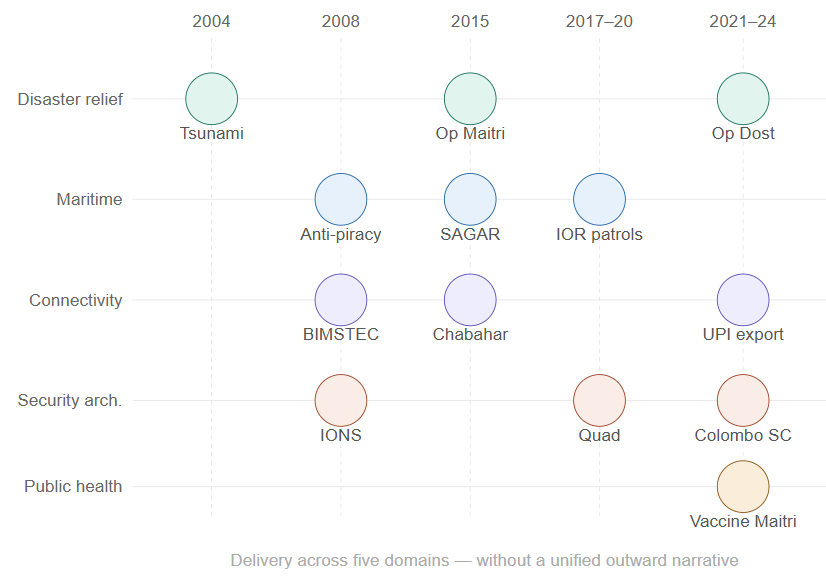
Similarly, regional organizations in the Indian Ocean suffer from limited implementation capacity and overlapping mandates. Even where India has delivered—in connectivity projects, energy cooperation, maritime capacity-building, and humanitarian response—these efforts remain fragmented in perception. Individual successes are not assembled into a coherent strategic narrative that regional audiences can identify and trust.
The issue is not absence of action, but failure of integration. India delivers quietly, while others—with fewer outcomes—define the story. This is not merely a communications problem; it reflects a deeper gap between operational instinct and strategic intent.
Maritime geography: Leverage without escalation
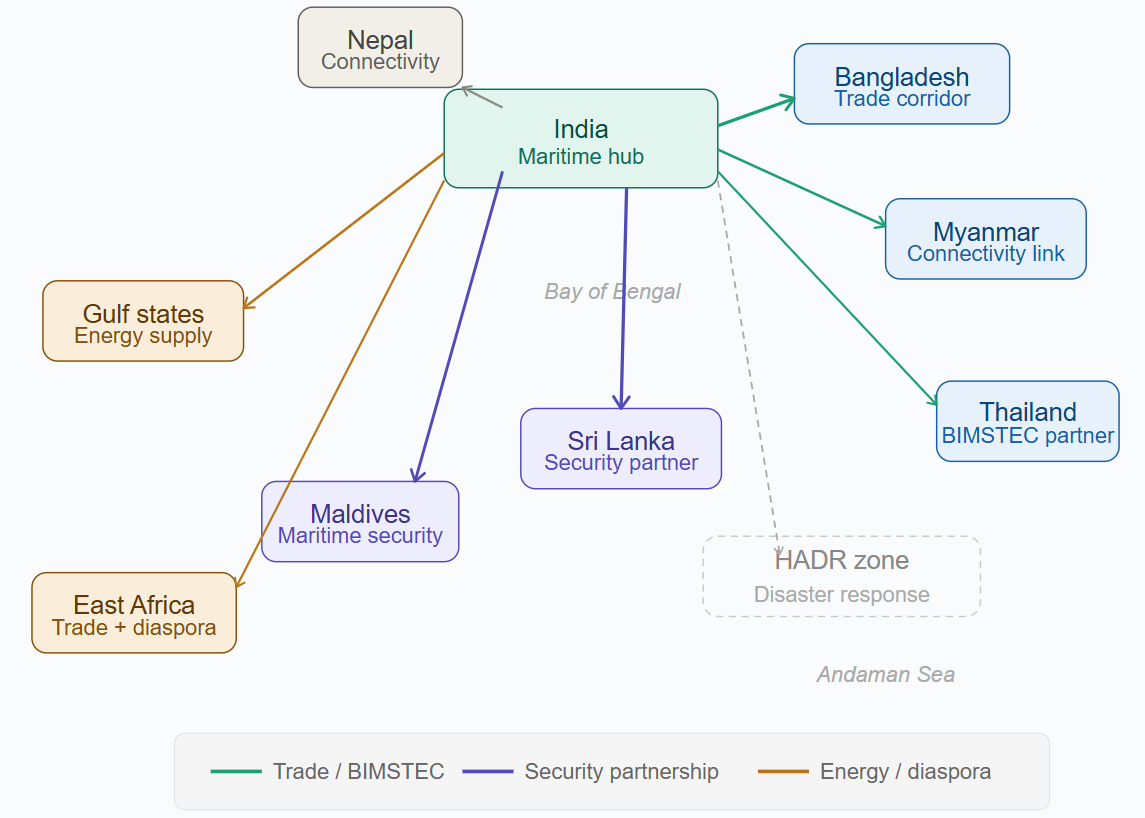
India’s most durable strategic advantage lies in its maritime geography. The Bay of Bengal, Arabian Sea, and Indian Ocean are not merely transit corridors; they are spaces of economic interdependence, crisis response, and norm formation—and India sits at their centre.
In the Bay of Bengal, India is already a central actor in trade flows, connectivity, and regional coordination. BIMSTEC, despite its institutional limitations, positions India as a natural convener. In the Arabian Sea, India’s role in energy security—as a major importer whose stability matters to Gulf partners, and as a maritime actor whose presence reassures smaller littoral states—positions it as a functional guarantor of order. Across the Indian Ocean, its record in humanitarian assistance, disaster relief, and public health interventions has established a pattern of reliable, non-transactional engagement.
These actions generate trust precisely because they are predictable and non-coercive. They accumulate into a reputation—one that is harder to build than a single dramatic intervention, but far more durable.
Yet their strategic value remains under-leveraged. India operates as a provider of stability but does not consistently project itself as a shaper of regional norms. The gap is not in performance, but in projection. Other actors—with less presence—are doing more to define the terms on which India’s presence is interpreted.
The credibility gap: Capacity without coherence
India’s position in the Indo-Pacific is defined by a productive paradox. It is widely regarded as a stabilizing force. Its operational record in maritime security, humanitarian response, and multilateral engagement is credible and increasingly recognized. It is seen, broadly, as a system-supporting actor rather than a disruptive one. And yet its influence remains below potential.
The reason is not material limitation, but narrative incoherence. India’s engagements are often reactive, its messaging fragmented, and its strategic intent insufficiently articulated to external audiences. This creates ambiguity—particularly among smaller states seeking long-term reliability. Ambiguity, in strategic affairs, is not neutral: it is interpreted in the direction of the prevailing narrative, which is rarely India’s.
At the same time, India’s balancing act—maintaining strategic autonomy while deepening partnerships with the United States, Japan, and others—risks being misread as hesitation rather than sovereignty. Without a clear narrative framework, autonomy looks like indecision. Without a coherent communication strategy, delivery looks like absence.
This is the credibility gap: the distance between what India does and what others perceive it to be doing. Closing it does not require changing behaviour. It requires converting behaviour into narrative.
Strategic priorities: From alignment to differentiation
India’s Indo-Pacific strategy must now move beyond declaratory alignment toward active narrative differentiation. This requires three concrete shifts.
First, operational delivery must be systematically integrated with strategic communication. India’s successes in maritime security, infrastructure, and regional cooperation must be framed—consistently and proactively—as components of a coherent model of partnership. The Colombo Security Conclave, the India-Sri Lanka-Maldives maritime cooperation framework, and India’s disaster response record in the Bay of Bengal are individual data points that need to be assembled into a legible doctrine. Delivery without framing is invisible.
Second, India must deepen its engagement with regional intellectual ecosystems. Narrative leadership is not built solely through state action; it is constructed in the spaces where regional elites form perceptions—think tanks, policy networks, academic institutions, and editorial communities across Southeast Asia, the Indian Ocean islands, and East Africa. China invests heavily in these spaces. India, with its linguistic, cultural, and institutional connections across the region, has natural advantages it has largely failed to activate systematically.
Third, India should anchor its leadership in issue-based domains where credibility compounds over time. Climate resilience and disaster risk reduction, maritime governance and the blue economy, supply chain security and critical minerals, and digital public infrastructure are all areas where India can lead through demonstrated expertise rather than contested geopolitical assertion. The Bay of Bengal, with its vulnerability to climate disruption and its dependence on Indian logistical capacity, offers an immediate testing ground. If India can position itself as the indispensable partner for Bay of Bengal resilience—not through declaration but through sustained institutional presence—it establishes a template replicable across the broader Indian Ocean.
The common thread across all three shifts is consistency. Narrative leadership in the Indo-Pacific is not built through summits or statements—it is built through the accumulation of reliable, predictable, non-transactional conduct over time. This is precisely the domain in which India’s structural characteristics—its democratic accountability, its non-coercive tradition, its civilizational depth in the region—are genuine assets, not rhetorical flourishes.
The unresolved tension at the heart of India’s strategy is this: if its advantage lies in autonomy, how does it build narrative leadership without that autonomy appearing performative to the very regional actors it seeks to reassure?
The unresolved tension
There is a harder question embedded in India’s strategic position—one the official discourse tends to elide. If India’s credibility rests partly on its non-alignment and strategic autonomy, how does it build narrative leadership without that autonomy appearing calculated or performative to the regional actors it seeks to reassure?
The answer lies in the nature of the commitments India makes and the specificity with which it makes them. Autonomy at the level of great power competition need not translate into ambiguity at the level of regional partnership. India can maintain independence in its U.S.-China balancing act while making very specific, binding, and reciprocal commitments to smaller regional states—on disaster response, maritime surveillance, infrastructure delivery, and trade facilitation. It is in the latter domain that credibility is built and tested.
States in the Indian Ocean littoral do not primarily evaluate India through the prism of the Quad or the U.S.-China rivalry. They evaluate it through the prism of whether India shows up, delivers, and respects their agency. An India that is strategically autonomous but regionally consistent is not a contradiction—it is a distinctive offer.
Conclusion
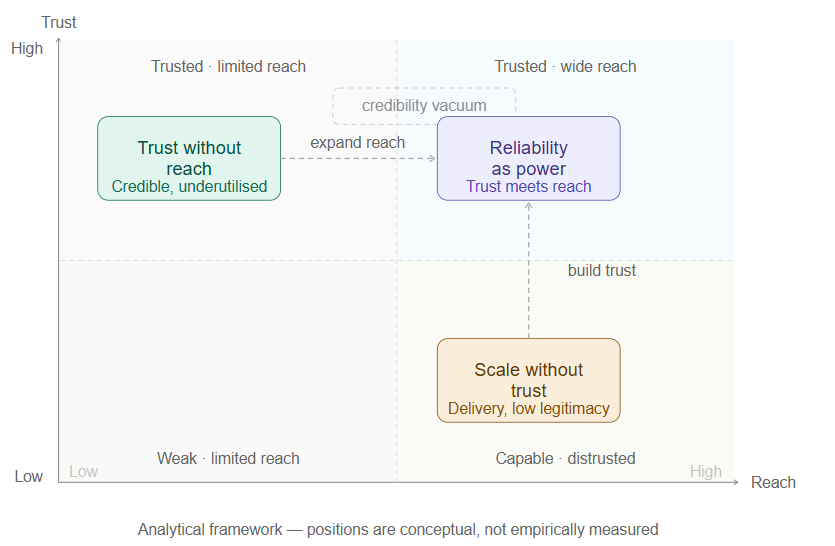
The Indo-Pacific is increasingly shaped by perceptions of trust, consistency, and delivery rather than by raw military capability or economic mass. The United States retains unmatched power but faces compounding questions of reliability. China delivers scale but struggles with trust. Between them lies a credibility vacuum.
India is uniquely positioned to occupy it—but only if it recognises that credibility alone is not sufficient. It must be converted into narrative, and narrative into institutional presence. The competition India faces is not primarily military; it is reputational. And reputations, unlike weapons systems, are built slowly and lost quickly.
India’s challenge, then, is not to outcompete major powers in the domains they have already claimed. It is to define a domain of its own—reliable, non-coercive, regionally rooted—and to ensure that this definition is seen, understood, and trusted across the Indo-Pacific.
In the current strategic environment, reliability is no longer a supporting attribute of power. It is power itself. And the state that best embodies it—consistently, visibly, over time—will shape the Indo-Pacific more durably than any naval deployment or infrastructure cheque.
That state could be India. Whether it will be depends on choices that are less about capability than about coherence.
Follow on X: The Quiet Cartographer
Interesting piece, definitely offers a unique way to look at the Indo-Pacific beyond the usual military balance of power dynamics.