
The Economy of Synchronized Desire
Why modern economic systems depend on millions of people wanting the same things at the same time
Modern economies have largely solved the problem of making things. What they have not solved — and what receives far less analytical attention — is the problem of ensuring that enough people want the same things at the same time for large-scale production to remain viable.
This is not a trivial challenge. Industrial production systems are built around volume and predictability. A garment factory, a semiconductor fab, or an automotive assembly line operates efficiently only when output is high and demand is foreseeable. When consumer preferences fragment across too many competing options, these systems become unstable: inventories accumulate, forecasts fail, and supply chains optimised for scale struggle to adapt.
The response of modern economies to this challenge has been to build a second layer of infrastructure alongside production — one designed not to make things, but to coordinate what people want. Advertising networks, media ecosystems, trending algorithms, and cultural recommendation systems all perform this function. They concentrate dispersed individual preferences into moments of collective attention, creating the temporary alignment of desire that large-scale production requires.
Understanding this coordination function changes how we read several features of the modern economy that are usually explained in other terms: the scale of global advertising spending, the power-law distribution of hits in entertainment and commerce, the economic significance of retail seasons, and the growing dominance of algorithmic platforms. Each of these, viewed structurally, is part of the same system — the infrastructure of synchronized desire.
Industrial civilization solved the problem of making things. The harder problem — ensuring enough people want the same things at the same time — has received far less attention.
Why production alone is not enough
For most of economic history, the central constraint on prosperity was production. Societies lacked the machinery, infrastructure, and organisational capacity to manufacture goods at scale. Economic progress therefore depended on expanding the ability to produce: building factories, mechanising labour, improving transport networks, and coordinating supply chains.
Over the past two centuries, industrialisation gradually resolved many of these constraints. The problem that replaced scarcity of production capacity is subtler: scarcity of convergent demand. In a world of abundant choice, consumers are surrounded by an unprecedented range of competing products, services, and cultural experiences. The stability of large-scale production systems now depends not simply on the ability to manufacture but on whether enough consumer demand converges on the same products within the same time window.
The global fashion sector illustrates the cost of convergence failure. Industry analysts estimate that approximately 20 percent of garments produced globally each year go unsold — representing roughly $500 billion in excess inventory annually. Some luxury brands have historically destroyed unsold stock to prevent price dilution, a practice that attracted public criticism but reflects a real structural logic: in industries that must commit to large production runs before knowing whether demand will materialise, the consequences of misjudging convergence are severe.
These are not isolated inefficiencies. They are symptoms of a fundamental tension between production systems designed for scale and a consumer environment in which preferences are continuously fragmenting. The question is not whether this tension exists — it clearly does — but how modern economies manage it.
Advertising as demand coordination infrastructure
The standard account of advertising treats it as persuasion: companies directing messages at individuals to influence purchasing decisions. This is accurate as far as it goes. But it misses the systemic function that advertising performs at scale.
When advertising directs large numbers of people toward the same products, brands, and cultural signals within the same time window, it performs a coordination function that is distinct from — and more important than — any individual persuasion. It concentrates dispersed preferences, creates shared awareness, and reduces the variance in what large populations want. In doing so, it generates the convergent demand that production systems require.
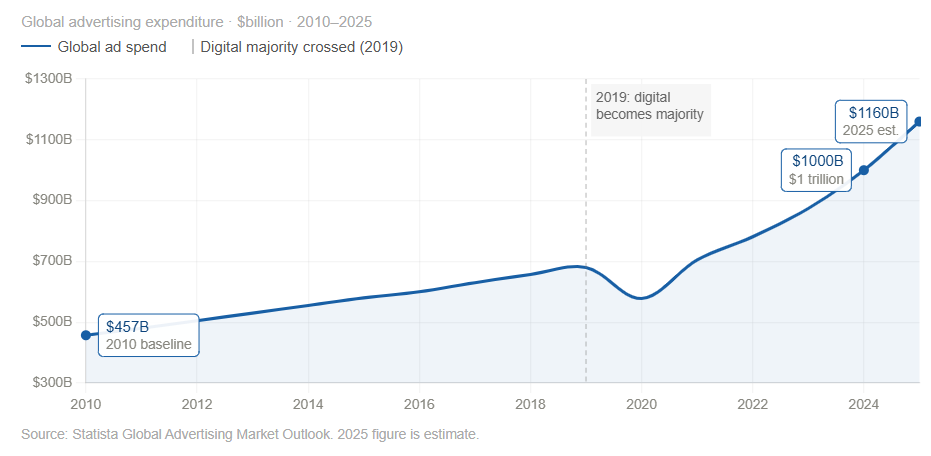
The scale of global advertising spending reflects the economic importance of this function. Global advertising expenditure reached approximately $1 trillion in 2024, having roughly doubled in real terms over the previous fifteen years. This growth tracks the expansion of global production capacity: as more goods required buyers, more resources were invested in ensuring buyers wanted them. The ratio is not coincidental — it reflects the structural dependence of production systems on demand coordination.
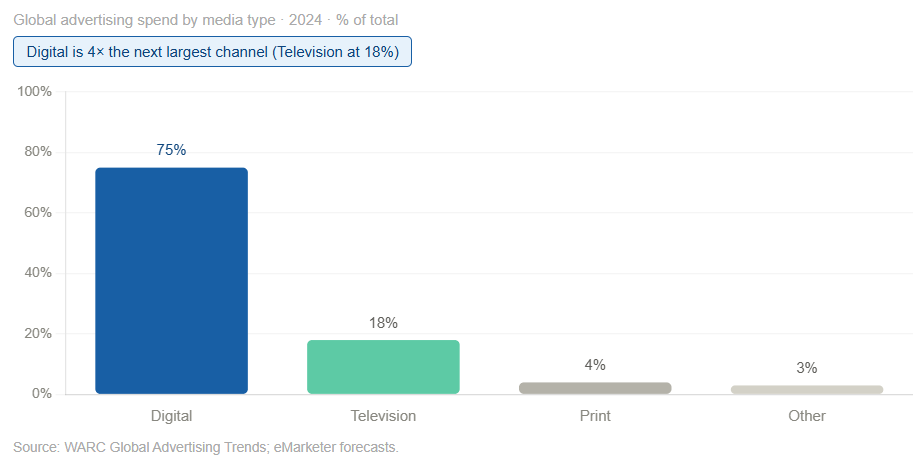
The shift toward digital advertising — which now accounts for approximately 75 percent of global spend against television’s 18 percent — reflects a further development: the migration of coordination infrastructure from broadcast media, which directed attention at scale but imprecisely, to algorithmic platforms that direct attention at scale with significantly greater precision. The coordination function has not changed. Its efficiency has improved dramatically.
Advertising is not primarily persuasion directed at individuals. It is coordination infrastructure directed at populations — concentrating dispersed preferences into convergent demand.
Algorithms and the compression of attention
Digital platforms have transformed the mechanisms through which consumer demand becomes synchronised, and the transformation has been more consequential than is usually acknowledged.
Recommendation systems used by streaming platforms, social networks, and online marketplaces do not present choices neutrally. They analyse patterns of engagement and amplify content that already shows traction, creating a feedback loop in which early signals of attention attract algorithmic promotion, which generates more attention, which reinforces the original signal. The effect is to compress dispersed curiosity into concentrated collective focus — and to do so faster and at greater scale than any previous coordination mechanism.
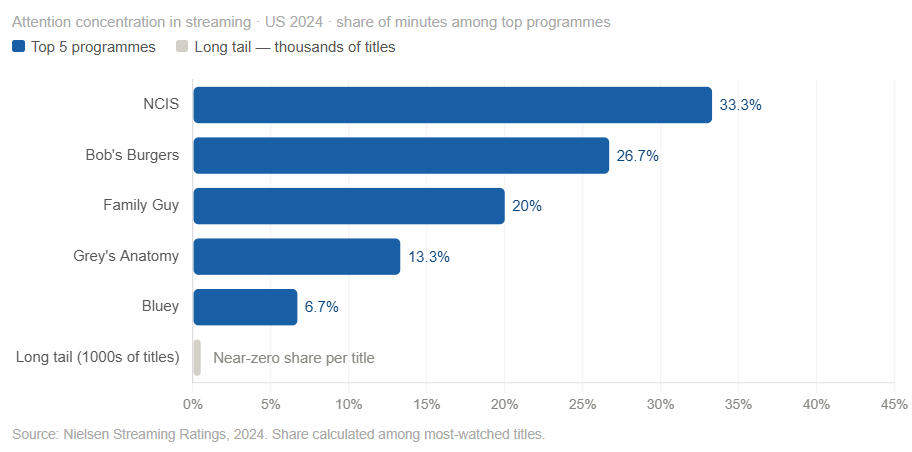
Streaming data illustrates the outcome. In 2024, total viewing across all streaming platforms in the United States exceeded 12 trillion minutes — yet a small number of programmes captured a disproportionate share of that attention. The top five most-streamed television programmes together accounted for a majority of viewing time among the most-watched titles, with NCIS alone representing approximately 33 percent of viewing within that group. This concentration is not simply a reflection of quality differences among programmes. It is the product of algorithmic systems that systematically amplify whichever signals first cross an attention threshold.
This dynamic creates a structural tension that the piece’s thesis must acknowledge honestly: algorithmic systems simultaneously concentrate some demand and fragment others. For every programme that becomes a hit through algorithmic amplification, dozens of others are rendered effectively invisible. The long tail of content and products receives diminishing attention as recommendation systems optimise for engagement signals. The result is a bifurcated attention economy — extreme concentration at the top, extreme fragmentation below — that creates instability in the middle tiers of production where most economic activity actually occurs.
The hit economy: power-law distributions in practice
If synchronised demand is a structural feature of modern markets, it should appear empirically in how consumption distributes across products and media. In practice, the pattern is visible across multiple industries, consistently and at scale.
Music streaming exhibits the most extreme concentration. Analyses of streaming patterns indicate that roughly 1 percent of artists generate more than 90 percent of streams on major platforms. The remaining 99 percent of artists — millions of performers — share the residual 10 percent of listening time. This is not a market that rewards quality across a normal distribution. It is a market structured by attention dynamics that produce winner-take-most outcomes regardless of the underlying distribution of quality.
Film markets show a comparable pattern. The top ten films typically account for approximately 35 to 40 percent of global box office revenue, despite representing a tiny fraction of total releases. Mobile app platforms exhibit similar distributions: the top 1 percent of publishers generate over 90 percent of revenue. Across each of these industries, demand does not spread evenly across many products. It clusters around a limited set of signals that attract collective attention — and in clustering, it creates the concentrated demand that makes large-scale production viable for the winners while undermining viability for the rest.
These power-law distributions are often described as natural market outcomes. They are not natural. They are produced by coordination infrastructure — by the algorithmic and media systems that direct attention, amplify early signals, and translate individual preference into collective behaviour. The hit economy is the economy of synchronised desire made visible.
Synchronisation and macroeconomic stability
The coordination of consumer desire does not only affect individual industries. It plays a broader role in macroeconomic stability that is rarely made explicit.
In most advanced economies, household consumption accounts for the majority of economic activity — approximately 68 to 70 percent of GDP in the United States, and between 55 and 65 percent across most European economies. When consumption patterns are relatively predictable, businesses can invest in production capacity with confidence. Stable demand allows firms to plan manufacturing runs, coordinate supply chains, and maintain steady employment levels.
Retail seasons provide the clearest illustration of how synchronised demand stabilises economic activity. The final two months of the year — November and December — account for approximately 19 to 20 percent of annual retail sales in the United States. This concentration is not simply a cultural tradition. It is an economically functional synchronisation event: a predictable window of convergent demand that allows businesses to plan production months in advance, coordinate logistics, and manage inventory efficiently. The economic significance of the holiday retail season reflects the structural value of predictable demand convergence — and explains the substantial investment that businesses make in ensuring that convergence occurs reliably each year.
When synchronisation fails or weakens, the macroeconomic consequences are real. Companies delay investment when demand signals become uncertain. Production slows as firms wait for clearer signals before committing to manufacturing runs. Inventory cycles become volatile as businesses attempt to interpret fragmented consumer behaviour. These dynamics — recognisable from the post-pandemic demand disruptions of 2021 to 2023, when supply chains struggled to respond to unpredictable consumption shifts — illustrate what happens when the coordination layer of the economy breaks down, even temporarily.
The fragmentation threat
The most significant risk to the economy of synchronised desire is not that coordination infrastructure will disappear. It is that the same digital systems that enhance coordination in some domains are simultaneously undermining it in others.
Algorithmic platforms optimise for engagement, which tends to produce concentration at the top of the attention distribution and fragmentation everywhere else. As content and product choices proliferate, the middle tier — the products and media that attract moderate but not dominant attention — becomes increasingly difficult to sustain commercially. This hollowing of the middle creates instability in exactly the segment of production where most employment and most economic activity is generated.
The response of incumbent industries has been to invest more heavily in hits — to concentrate production resources on the products most likely to break through the algorithmic threshold and achieve synchronised demand at scale. This defensive strategy is rational for individual firms but collectively self-defeating: it further reduces diversity in what gets produced, which in turn narrows the range of cultural and commercial signals available for synchronisation. The system optimises itself toward fragility.
Whether digital coordination infrastructure ultimately concentrates or fragments demand — and in what proportions across different sectors — is one of the more consequential open questions in the political economy of the next decade. The answer will partly determine whether the abundance of production capacity that industrialisation created translates into broadly distributed prosperity, or whether it concentrates value among the small number of producers capable of manufacturing hits at scale.
Conclusion
Modern economies produce two outputs simultaneously. The first is material: the goods and services generated by global production systems. The second is less visible but equally important: the temporary alignment in what large populations want. Factories manufacture objects. Media ecosystems, advertising networks, and algorithmic platforms manufacture coordination.
This second output is not a side effect of the entertainment and technology industries. It is a structural requirement of an economy built around large-scale production in a world of abundant choice. Without periodic moments of synchronised desire — holiday retail seasons, cultural hits, trending products — production systems designed for volume would face chronic instability as demand fragmented across too many competing signals.
The challenge for the next decade is not that this coordination system will fail entirely. It is that the same digital infrastructure that makes coordination more efficient at the top of the attention distribution simultaneously makes it more fragile in the middle — and that the economic consequences of that fragility fall disproportionately on the producers, workers, and communities that depend on the middle tier for their livelihoods.
Industrial civilisation solved the problem of making things. The digital economy is now managing the consequences of having solved it too well — navigating an environment in which the ability to produce vastly outstrips the ability to ensure, reliably and at scale, that enough people want what is being produced.
Follow on X: The Quiet Cartographer