
The Cognitive Footprint
Why war lists reveal the analyst, not the future
There is a recurring genre of strategic writing that feels authoritative because it is structured as enumeration. A list of wars. A list of scenarios. A sequence of future conflicts arranged neatly across geography and time. One such piece circulates in Indian strategic commentary: a response from the Centre for Land Warfare Studies (CLAWS) to a Chinese projection of “six wars China is sure to fight in the next fifty years.” It spans theatres — Taiwan, the South China Sea, India, Japan, Mongolia, Russia — and produces the impression that the future, once correctly identified, can be catalogued.
The impression is false. But not in the way most critics of such pieces suggest. The problem is not that the scenarios are wrong. Some of them may not be. The problem is the method — and what that method reveals about the analytical tradition producing it.
War lists are cognitively satisfying because they resolve ambiguity. They take an unstable system — geopolitics — and convert it into discrete, countable outcomes. This conversion feels analytical. It imposes structure. It allows uncertainty to be handled as enumeration rather than as probability. However, the underlying assumption is structural, not empirical: that strategic reality behaves like a schedule. That intent is stable over time. That escalation follows a linear path. That theatres of conflict operate independently even when described together. Remove those assumptions and the list collapses — not into evidence of the opposite, but into something more uncomfortable: a document that says more about how the analyst organises uncertainty than about how the system actually behaves.
The CLAWS piece is not a failed prediction. It is a cognitive footprint — a record of how uncertainty is domesticated within a particular strategic imagination. It reveals a specific cognition pattern: threat perception segmented by territory; adversary behaviour treated as intention-driven and legible; multi-theatre dynamics assumed to be independent but simultaneous. It converts a coupled system into separate scenario bins. That tells us something real — about the analytical instincts of the environment that produced it, not about the wars it claims to forecast.
A different interpretive tradition offers a useful contrast. Editorial and analytical discourse from Taiwan — the ecosystem of commentary around outlets like the Taipei Times and the strategic analysis circulating through Taiwanese security institutions — approaches the same regional tensions through a fundamentally different frame.
In this tradition, the Taiwan Strait is not a countdown toward a single kinetic endpoint. It is a sustained environment of signalling, coercion, and narrative competition. Military activity is read not primarily as a precursor to war but as part of a continuous system in which perception is itself a domain of contestation. The question is not when war happens. The question is how stability and pressure are simultaneously maintained within the same system — and for how long.
The ADIZ incursion data fits this frame far better than any war list. Taiwan’s Ministry of National Defence recorded 1,737 PLA aircraft incursions into its Air Defence Identification Zone in 2022, and 1,714 in 2023 — a near-identical plateau across two consecutive years. These figures do not map onto linear escalation toward war. They describe a persistent pressure system — neither peace nor conflict in any conventional sense — where escalation is implied, not executed, and where the meaning of an action is often more consequential than its immediate material effect.
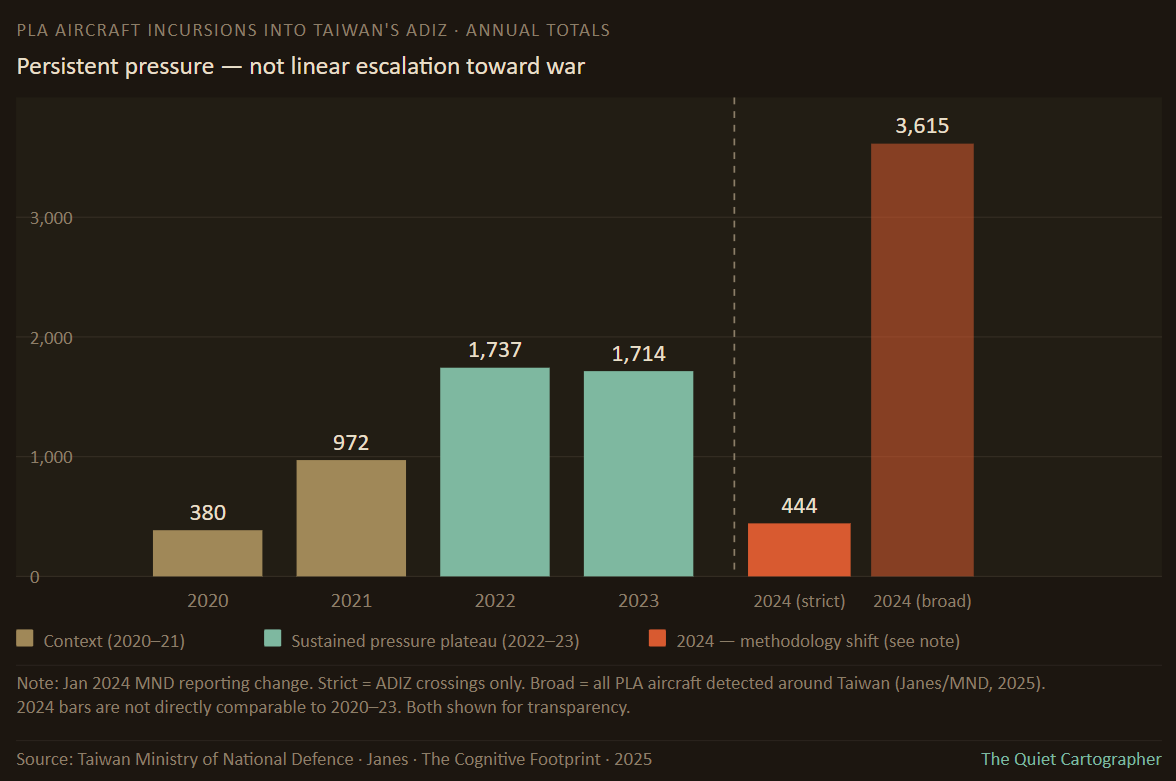
The military spending asymmetry matters here, though not in the way it is typically presented. China’s defence expenditure reached approximately $296 billion in 2023, the second largest globally. India’s in the same period was $83.6 billion (SIPRI Military Expenditure Database, 2024 release). The gap is real and persistent.
But asymmetry shapes the constraint landscape — what actors believe is feasible, where risk tolerance calculates out — not a war timeline. Capability is not intent. The ability to fight in a given theatre is not the same as a decision to initiate. Treating a capability gap as a predictive trigger is one of the cleaner examples of the conflation that war-list thinking produces, and it is worth naming the full set of them clearly.
Scenario writing is not doctrine. Signalling is not commitment. Capability is not intent. Each conflation is individually obvious. Collectively, they produce a coherent but distorted picture — one where the future is legible, the adversary’s mind is readable, and the analyst’s job is enumeration rather than probabilistic modelling.
A qualification is worth making explicit. The ambiguity-system frame fits Taiwan’s reality more naturally than India’s, because Taiwan operates inside a continuous pressure field — the ADIZ data is the lived condition, not an analytical abstraction. India’s experience of Chinese pressure along the LAC is more episodic: punctuated by standoffs, mediated by terrain, and separated by long periods of managed friction rather than daily incursion. The war-list critique applies equally to both contexts — the methodological distortion is the same regardless of which version of the threat you face. But the Taipei Times tradition is not a ready-made template for Indian strategic analysis. It is a corrective lens, not a direct substitute. The pressure field in the Taiwan Strait and the pressure field along the Himalayas are different systems. The analytical instinct they call for is similar. The geometry is not.
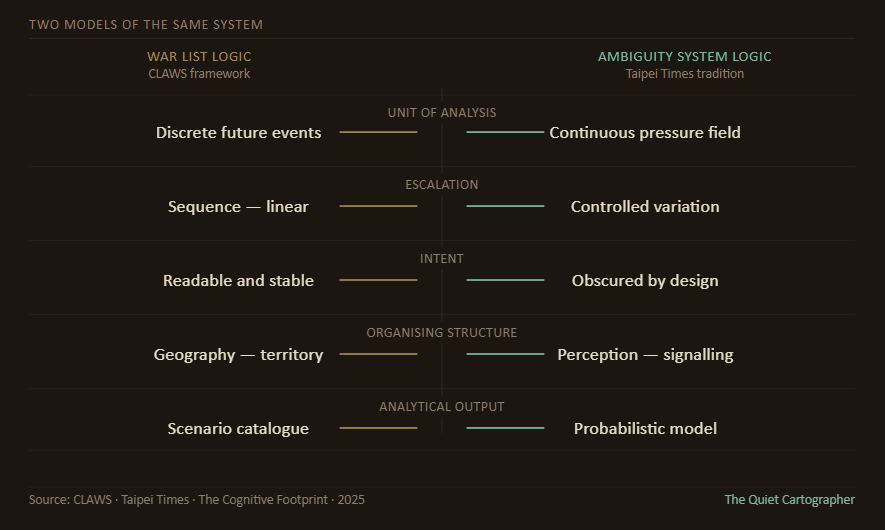
Placed alongside each other, the two models are not debating outcomes. They cannot — they don’t share a unit of analysis.
The war-list logic treats conflict as discrete future events, escalation as sequence, geography as organising structure, and intent as readable. The ambiguity-system logic treats conflict as a continuous pressure field, escalation as controlled variation, and intent as partially obscured by design — because in this system, ambiguity is not a failure of intelligence. It is a strategic instrument.
This is where a three-layer structure becomes useful — not as a predictive tool but as a diagnostic one.
The first layer is kinetic: military modernisation, deployments, capability growth. The material substrate. Real, measurable, slow-moving relative to perception. The second is the signal layer: exercises, speeches, think-tank projections, strategic commentary. Produced by states and analysts alike. Designed to be read — and misread. The third is the interpretation layer: how states, analysts, and publics convert signals into belief about intent. This is the dominant layer. It precedes events. It often constrains them.
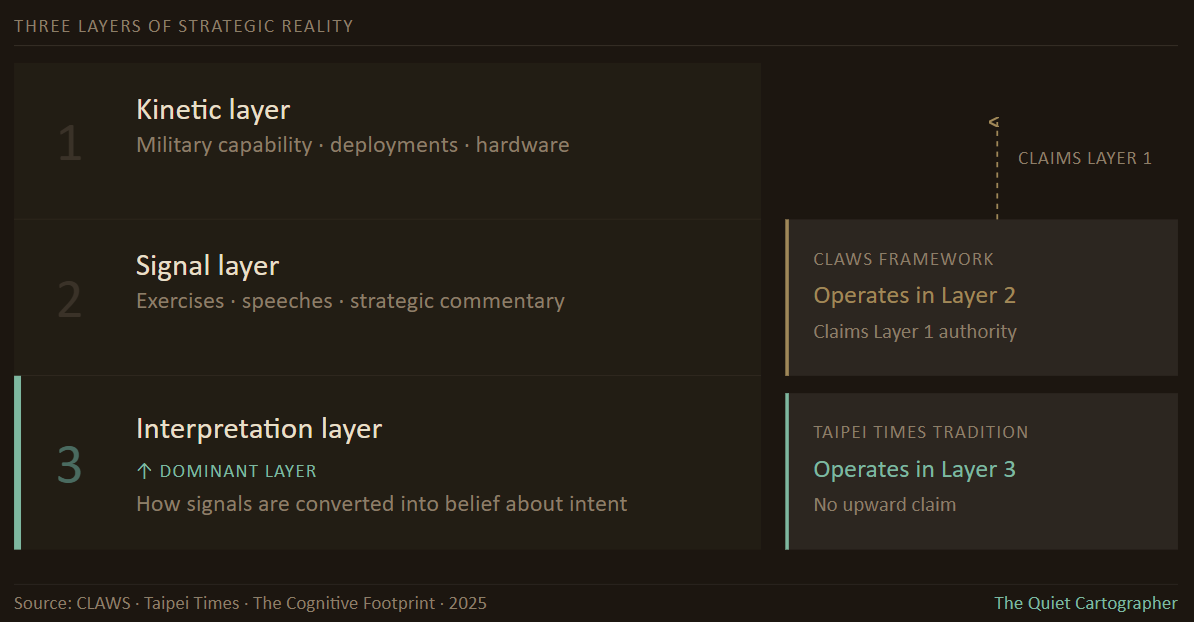
Most strategic writing operates in the second layer but presents itself as speaking from the first. The CLAWS piece is signal-layer material — a projection, a framing artifact — that claims the epistemic authority of kinetic-layer analysis. That is where the distortion enters. The Taipei Times ecosystem, by contrast, tends to operate explicitly in the interpretation layer. It asks how meaning is being constructed and contested. It is not more accurate about outcomes. It is more honest about the layer it is actually working in.
What emerges from placing these two traditions alongside each other is not a better war list. It is a shift in what the central question actually is.
The question is not which war comes first. The more structurally important question is which interpretive model is shaping how actors understand the system they are already inside — because in environments defined by signalling and managed ambiguity, perception does not follow events passively. It precedes them. It constrains them. Sometimes it produces them.
The real contest is not over which war list turns out to be accurate. It is over which way of seeing the system becomes the dominant lens before any list is tested by events.
Author’s note: A note on method and position. One of my professors during my postgraduate program, in a seminar on organisational change, said something that has stayed with me: “our work is always an interpretation of an interpretation.” That is precisely what this piece is. I am not a defence analyst. I am reading strategic analysts reading events — and then reading that. The three-layer framework in this article applies to my own position as much as to anyone else’s. I occupy the interpretation layer. I have tried to be honest about which layer I am working in. That honesty is the only claim to rigour I can make here.
Follow on X: The Quiet Cartographer
Sources and additional reading:
Military Implications of PLA Aircraft Incursions in Taiwan’s Airspace 2024
Responding to Chinese Article on the-Six Wars China is Sure to Fight in the next 50 Years
Strange patterns: Growing complexity of Chinese activity in Taiwan’s ADIZ
2022 in ADIZ Violations: China Dials Up the Pressure on Taiwan
What’s interesting here is that the “cognitive footprint” is not just individual, but structural.
Over time, tools shape not only how we think, but what we are able to perceive as relevant.