
The Apple of Discord: Cuba, Russian Oil, and the Fractures of American Power
Access, not alignment, is now the decisive variable in the Western Hemisphere
Cuba is not returning to crisis. It never left it. What has changed is not the condition of the island but the visibility of the forces acting upon it. In the span of a few months, Cuba has become the most legible point in a system under strain. A place where the contradictions of American power, Russian adaptation, and structural energy dependency converge into a single, observable moment.
That moment arrived on March 30, when a sanctioned Russian tanker, the Anatoly Kolodkin, docked at the port of Matanzas carrying 730,000 barrels of crude oil. It was Cuba’s first significant delivery in three months. The vessel was sanctioned by the United States, the European Union, and the United Kingdom. It arrived anyway.
This is not an energy story. It is a systems story.
How Cuba Got Here
To understand what the tanker’s arrival means, the starting point is not Havana but Venezuela. For years, Venezuela functioned as the external input that sustained Cuba’s internal continuity. Oil shipments under preferential arrangements supported electricity generation, transport networks, and baseline economic activity. At its peak, Venezuela produced over three million barrels per day. That figure contracted sharply, settling between 700,000 and 900,000 barrels in recent cycles. As output declined, so did its ability to sustain external commitments. Cuba did not collapse inward. It absorbed the withdrawal of a system it had come to depend upon.
At various points, as much as 60 to 70 percent of Cuba’s fuel imports originated from Venezuela. This was not a marginal relationship. It was architectural. When that flow weakened, the effects propagated immediately. Electricity faltered first. Then transport. Then everything that relies on both.
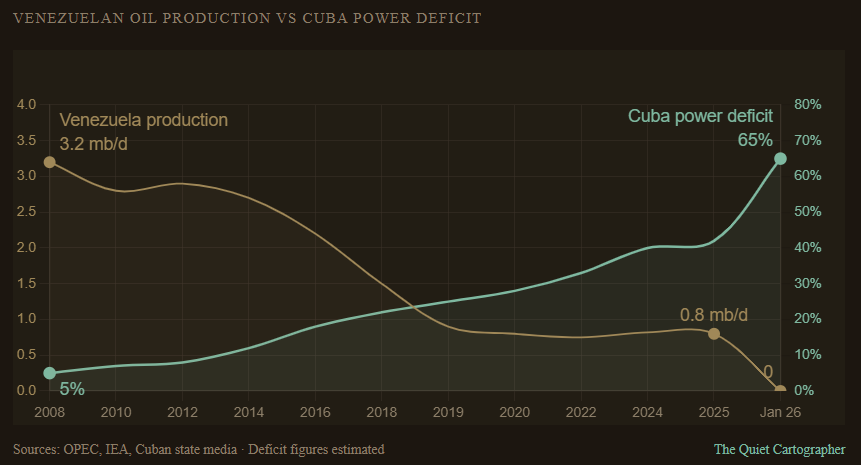
The final rupture came in early January 2026, when the United States launched a military operation that removed Nicolás Maduro from power. Mexico, which had partially filled the gap, halted its deliveries shortly after Washington threatened tariffs on any country supplying crude to the island. Cuba was left exposed in a way that had no near-term domestic remedy. The grid failed. Blackouts stretched across the island. Hospitals struggled to maintain emergency and intensive care services. The United Nations warned of a humanitarian crisis. A system designed around continuity was forced into interruption.
Every shipment now matters because the system has no redundancy.
The Architecture of Pressure
What followed was not simply an energy shortage. It was the expression of a deliberate policy architecture — one designed, in the words of its architects, to bring the Cuban government to a point of desperation sufficient to force political change.
Sanctions did not create this fragility. They defined its boundaries. The policy architecture of the United States has, particularly since 2019, targeted the channels through which Cuba accesses external inputs. Shipping, insurance, and financial intermediaries became pressure points. Each restriction raised the cost of stabilisation. The objective was not immediate collapse but cumulative constraint.
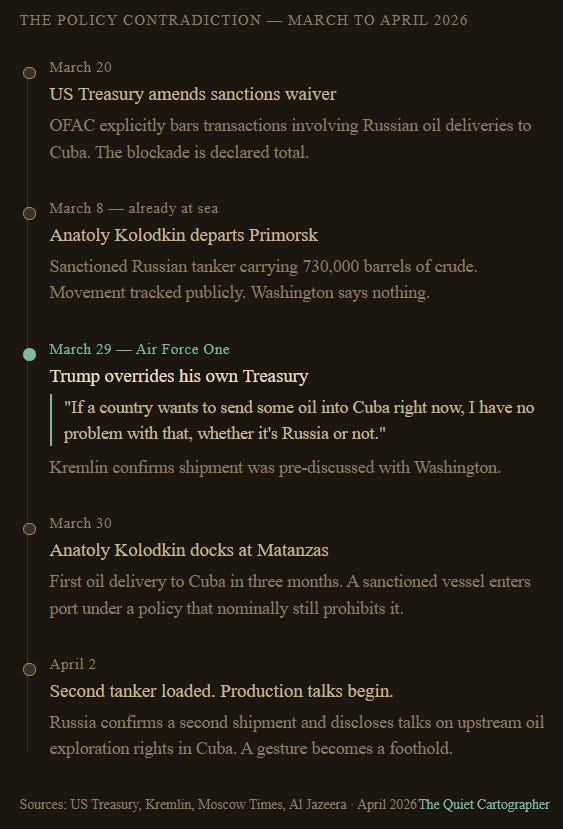
After Maduro’s removal and the halt of Venezuelan supplies, the administration moved to formalise the blockade. The US Treasury’s Office of Foreign Assets Control amended a sanctions waiver to explicitly bar transactions involving Russian oil deliveries to Cuba, adding the island to a list of countries blocked from receiving Russian-origin petroleum products. The coercive logic appeared to be working. The policy position was total. No oil in, regardless of source, until political conditions changed.
The Probe
Russia’s response was calibrated in the way that Russian responses in contested spaces typically are: not a confrontation, but a complication. Russia did not escalate. It probed. The probe was not the shipment. It was the question embedded in it. Who controls access?
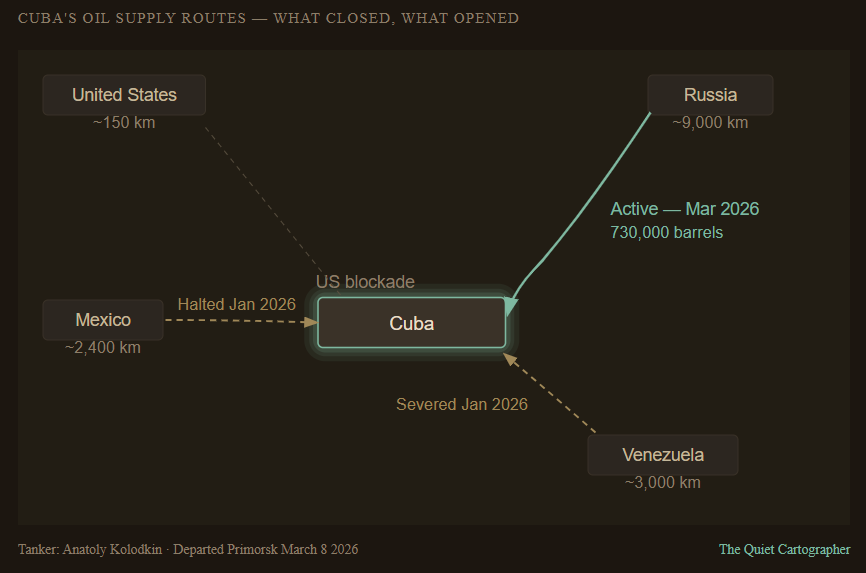
When Anatoly Kolodkin departed Primorsk carrying 730,000 barrels of crude, the shipment was not concealed. It was meant to be seen. Russia’s Energy Minister Sergei Tsivilev confirmed the shipment publicly, describing it as humanitarian assistance. “Cuba has found itself in a difficult situation as a result of sanctions pressure,” he told reporters. “That is why we are currently sending humanitarian supplies.” The framing was intentional. Humanitarian language insulates an action from being characterised as a geopolitical challenge while achieving precisely that effect. It also places the burden of escalation on the party that would choose to intercept it.
The Kremlin went further. Spokesman Dmitry Peskov stated that Russia had discussed the oil shipment with the United States in advance of delivery. This was not, then, defiance that Washington was forced to reluctantly accept. It was, apparently, coordinated — or at minimum, permitted after negotiation. The distinction matters enormously for what it signals downstream.
The Blink
What happened next is the analytical centrepiece of this moment, and the reason Cuba has become something more than an energy story.
As the vessel approached Cuban waters, Donald Trump was asked about it aboard Air Force One. “If a country wants to send some oil into Cuba right now, I have no problem with that, whether it’s Russia or not,” he said. “I’d prefer letting it in, whether it’s Russia or anybody else, because the people need heat and cooling and all of the other things that you need.” The statement overrode, in real time, a sanctions position his own administration had formalised days earlier.
This was not inconsistency. It was selective enforcement under negotiation.
As the vessel docked, Cuba’s Energy and Mines Minister celebrated the arrival publicly. Russia’s Foreign Ministry spokesperson Maria Zakharova announced that assistance would continue. Tsivilev confirmed a second tanker was already being loaded. He also disclosed that the two sides had made progress in talks on increasing Russian companies’ participation in oil exploration and production in Cuba. What began as a single shipment had, within days, become a declared supply relationship — with upstream production rights on the table.
What the NSS Says, and What It Cannot Do
The significance of this sequence becomes clearer when placed against the doctrine it quietly displaced. The Trump administration’s National Security Strategy, released in November 2025, articulated what it called a “Trump Corollary” to the Monroe Doctrine — an explicit commitment to denying “non-Hemispheric competitors the ability to position forces or other threatening capabilities, or to own or control strategically vital assets” in the Western Hemisphere.
The language was written with Cuba, Venezuela, and Nicaragua in mind. Under its logic, a Russian-flagged tanker docking in Havana is not merely an energy transaction. It is precisely the kind of hemispheric incursion the doctrine was designed to prevent. The NSS stated further that the terms of American alliances and aid would be “contingent on winding down adversarial outside influence.” Mexico read that correctly and stopped its shipments. Russia read the same document and sent the tanker anyway.
The gap between declared doctrine and actual enforcement is not a contradiction. It is the signal. It establishes that American enforcement is conditional, contingent, and subject to negotiation in real time in the hemisphere — and beyond.
There is a structural reason for this gap that goes beyond Trump’s transactional instincts. The mass dismissals across the State Department, Department of Defense, and intelligence community over recent months have hollowed the institutional layer that monitors shadow fleet movements, processes sanctions enforcement, coordinates secondary pressure with allies, and flags anomalies in port activity. The NSS articulates maximum ambition toward Cuba’s external supply relationships at precisely the moment the apparatus to execute that ambition is being degraded.
Russia does not need to challenge the doctrine directly. It only needs to operate in the space where enforcement is under strain.
The Asymmetry That Now Exists
The result is a new asymmetry that will not simply reset when the next policy statement is issued.
Mexico halted shipments when threatened. Russia did not, and faced no consequences. The US Treasury tightened a waiver; the US president overrode it in public. The Kremlin confirmed the shipment had been pre-discussed with Washington. A second tanker was loaded. Production talks began.
For every government in the hemisphere now weighing whether to comply with American pressure on Cuba or elsewhere, this sequence is instructive. Compliance is not guaranteed to be rewarded. Non-compliance, if you possess sufficient leverage, may simply be accommodated. The credibility of American enforcement as a deterrent has taken a specific and legible hit — not through a dramatic confrontation, but through the quiet collapse of a policy the administration itself had publicly declared.
It is worth being precise about what this does and does not mean. The current US-Russia accommodation on Cuba may well be a one-off — a transaction embedded in broader Ukraine negotiations, or simply the outcome of a moment when Trump’s humanitarian instincts overrode his administration’s declared strategy. The unpredictability of this American government is real, and the next shipment might be blocked where this one was waved through.
This unpredictability is itself the signal, not a caveat to it. The instability of enforcement is now legible to all parties. Whether the next Russian tanker is stopped or permitted almost doesn’t matter. The precedent that it can be negotiated has been set. Russia, more than any other actor in this space, knows how to operate in that kind of ambiguity. It does not need dominance where variability is enough.
Cuba as Function, Not Actor
Cuba did not generate this crisis. It is not an actor, but a function. Its significance lies not in its capacity but in its position. It sits at the intersection of Venezuelan supply collapse, American restriction, Russian probing, and a strategic doctrine whose enforcement has already been publicly abandoned once.
To describe Cuba as an Apple of Discord is not to assign it agency. It is to recognise its role as a point of convergence. A constrained space becomes the site where larger tensions surface, not because it creates conflict, but because it makes unresolved conflicts visible.
What the Anatoly Kolodkin demonstrated is that access, not alignment, now governs outcomes. Russia did not need an alliance, a base, or a confrontation to alter the regional equation. It needed a single shipment, a pre-arranged conversation with Washington, a president willing to override his own Treasury on camera — a system willing to negotiate its own rules.
The next question is not whether Cuba stabilises. It is who is permitted — and on what terms — to enable that stabilisation. Russia has now established that it can be that party, at least some of the time. It has also established, through the production talks, that it intends to convert a humanitarian gesture into a structural foothold.
What began in Venezuela does not end in Cuba. What follows will not be determined in Havana alone. It will be decided in the space between access and denial, and who, at any given moment, has the leverage to shape that boundary.
Follow on X: The Quiet Cartographer
I disagree. There was a russian frigate, plus a submarine somewhere, with them. That means fighting a russian frigate/marines for control of a russian tanker. The US will win the fight ofcourse, but it will start ww3. Did the russians tell the US "We're sending oil , escorted by our frigate, delivered by our ship" ? Maybe, but they didn't ask permission or negotiate. The US could stop the oil, but not like in Venezuela, without a fight.
The shipments were under Russian flag, escorted by a russia frigate. How would the US enforce its rules against Russia, without a military confuntation? Going to war , for an illegal blockade?Ww3 over cuban oil? Lol. It's that simple.