
Sovereignty Isn’t Absolute—It’s Negotiated
Why the “rules-based order” applies differently depending on who invokes it
Sovereignty is one of the most invoked words in international politics. It is also one of the most selectively applied.
States reach for it to defend borders, justify interventions, and claim legitimacy within the international system. It is presented as a fixed principle — universal, non-negotiable, the bedrock of the rules-based order. The gap between that presentation and observable reality is not subtle. It is structural. And understanding it is essential to understanding how the international system actually operates, as opposed to how it describes itself.
Not a rule. A language.
Sovereignty today functions less as an enforceable rule and more as a strategic language — invoked when useful, reinterpreted when inconvenient, and set aside when strategic necessity demands it. The consistency is in the rhetoric. The inconsistency is in the application.
This is the upstream signal: the rules-based order was never a neutral system of enforceable norms. It is a measurement framework built by states with the power to define what counts as a violation, who gets to adjudicate it, and what consequences follow. The rules are real. But their application reflects prevailing power alignments, not abstract principle.
The cases make this visible.
Four cases. One pattern.
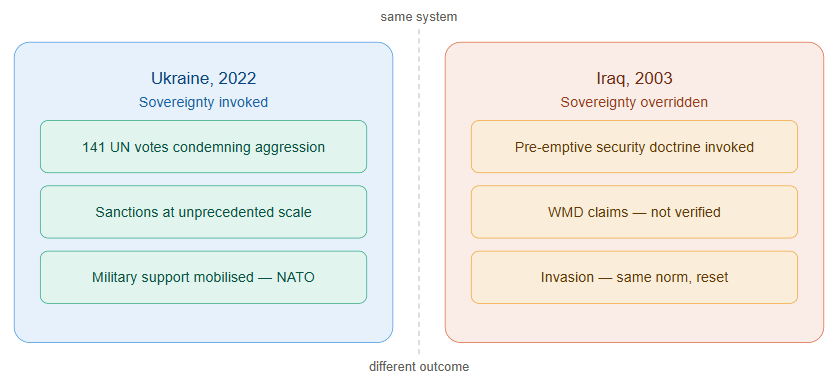
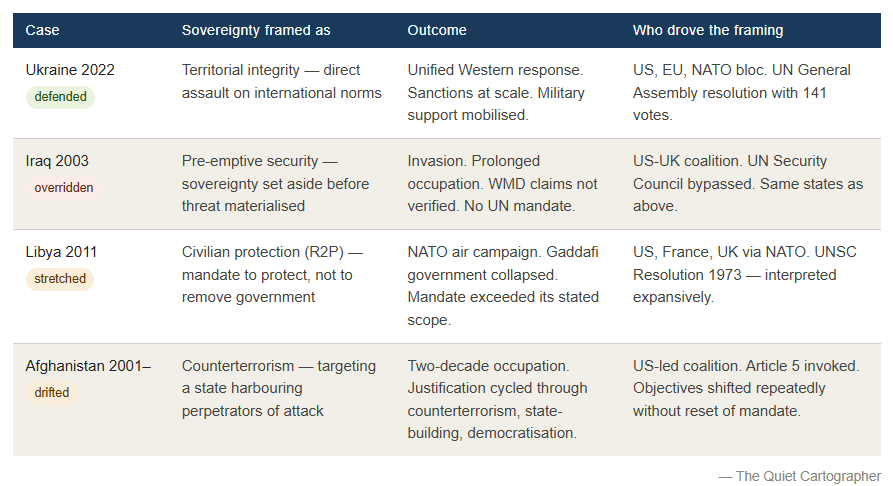
Ukraine, 2022. The Russian invasion of Ukraine produced one of the most unified Western responses in decades. The violation of territorial integrity was framed immediately and consistently as an assault on international norms — not merely on Ukraine. Sanctions were imposed at unprecedented scale. Military and financial support was mobilised across NATO members. The principle of sovereignty was asserted with clarity, urgency, and institutional weight. The UN General Assembly passed Resolution ES-11/1 condemning the aggression with 141 votes in favour.
The response was real, substantial, and consequential. It was also selective — not in the sense that Ukraine didn’t deserve it, but in the sense that the same institutional energy has not been consistently available for comparable violations.
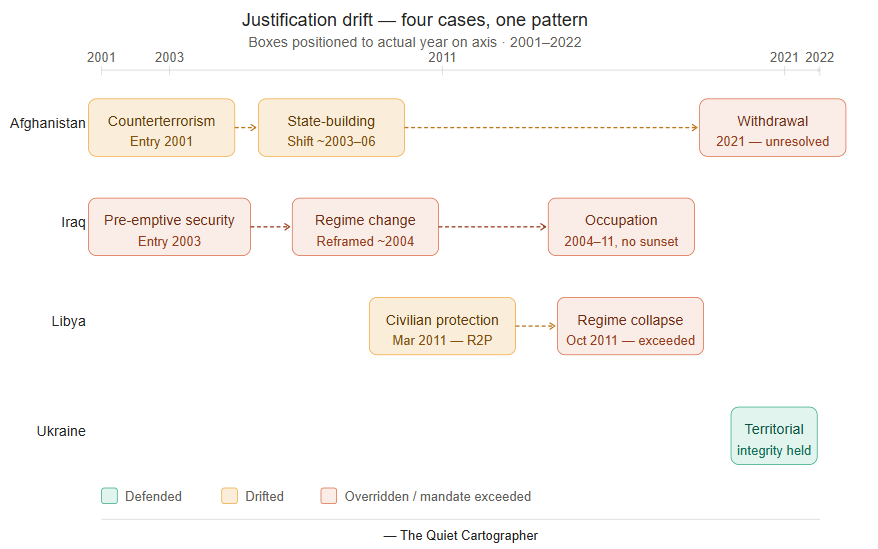
Iraq, 2003. The US-led invasion of Iraq did not invoke territorial integrity. It invoked pre-emptive security — the doctrine that a state may override another’s sovereignty in anticipation of a threat not yet materialised. The Authorization for Use of Military Force Against Iraq, passed by the US Congress in 2002, rested on claims about weapons of mass destruction that subsequent investigation did not substantiate. Sovereignty was not defended here. It was redefined — the conditions under which it could be set aside were expanded, by the same states that would later frame Ukraine’s defence as a matter of universal principle.
The structural observation is not that one response was right and the other wrong. It is that the same framework produced opposite outcomes depending on who was invoking it and against whom.
Libya, 2011. UN Security Council Resolution 1973 authorised a no-fly zone over Libya and measures to protect civilians — framed explicitly under the Responsibility to Protect doctrine, the international community’s stated commitment to intervention when a state fails to protect its own population. What followed was a NATO air campaign that contributed directly to the collapse of the Gaddafi government. The mandate had authorised civilian protection. It was used for regime change. The elasticity of the justification — and the absence of accountability for that stretch — revealed something important: intervention norms are interpreted in real time, by the states with the capability to act on them.
Afghanistan, 2001 onwards. The initial intervention following the September 11 attacks had a coherent justification — the Taliban government was harbouring the organisation responsible for the attacks, and had refused to act. What followed was a two-decade occupation that cycled through justifications: counterterrorism, state-building, democratisation, regional stability. Each new objective reset the terms under which presence was legitimised. By the end, the strategic rationale had shifted so many times that the original sovereignty override had become almost incidental to the ongoing operation.
The most underexamined tool: Economic sovereignty
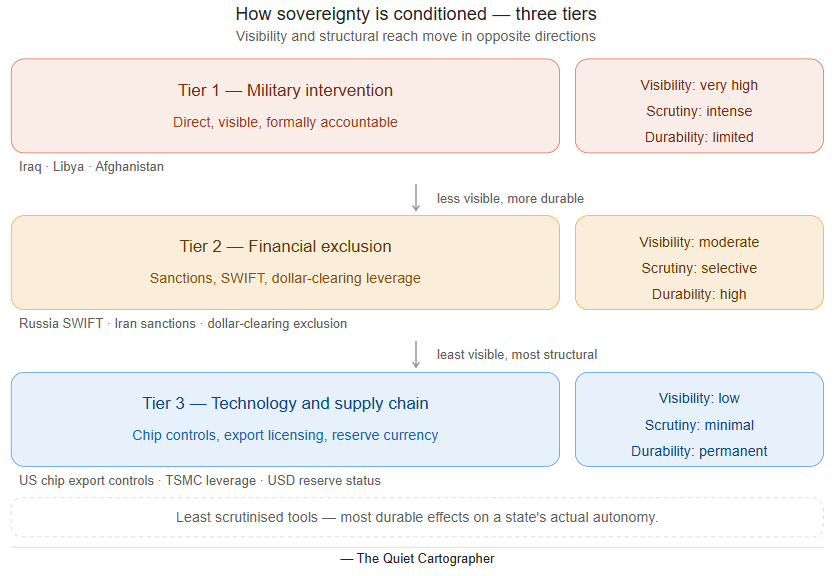
Military intervention is the most visible form of sovereignty override. It is not the most common.
Sanctions regimes, trade restrictions, technology controls, and dominance over financial infrastructure allow states to condition the exercise of sovereignty without crossing a single border. These tools operate below the threshold of formal violation — and precisely because they do, they attract far less scrutiny than military action, while often producing comparable effects on a state’s actual autonomy.
The architecture is instructive. The US dollar’s role as the world’s primary reserve currency means that access to the global financial system runs through American regulatory jurisdiction. Dollar-clearing banks must comply with US sanctions or lose access to that system. The result is that US financial policy has extraterritorial reach — it shapes the behaviour of institutions and states that are formally outside American jurisdiction.
SWIFT disconnection — the removal of states from the global interbank messaging system — has become a standard instrument of pressure. Russia’s partial disconnection in 2022 was significant. But the tool existed long before Ukraine, and its use against Iran demonstrated its reach: a country can be effectively isolated from global commerce without a single act that formally violates its territorial integrity.
Export controls on semiconductors and advanced technology represent a newer variant of the same logic. A state’s capacity to develop sovereign technological capability — its ability to build its own AI, its own advanced manufacturing, its own defence systems — can be constrained from outside its borders, through supply chain architecture and licensing regimes. The sovereignty being conditioned here is not territorial. It is developmental.
These are not peripheral instruments. They are, increasingly, the primary tools through which powerful states shape the behaviour of others. They operate within the letter of the rules-based order while systematically conditioning what sovereignty means in practice.
The structural point
The inconsistency in how sovereignty is applied is not primarily a story about hypocrisy — though hypocrisy is a natural response when you notice the gap. Hypocrisy implies that the stated principle is the real principle, and that actors are simply failing to live up to it.
The more accurate diagnosis is structural. The rules-based order was constructed by states with the power to define what counts as a violation, establish the institutions that adjudicate disputes, and determine what consequences follow from a finding. It was always going to reflect their interests and alignments. The rules are real — they constrain behaviour, shape expectations, and carry genuine normative weight. But their application has never been — and was never designed to be — neutral.
This produces a specific dynamic. Sovereignty is simultaneously a genuine principle and a strategic instrument. States invoke it in good faith when their interests align with its consistent application. They reinterpret it when they don’t. The system accommodates both — because the system was built to accommodate both.
“To take sovereignty at face value is to misunderstand how the international system operates. To dismiss it entirely is to ignore the language through which that system justifies itself. The accurate view lies in between: sovereignty is neither absolute nor irrelevant. It is negotiated — repeatedly, visibly, and often unequally.”
What this means for analysis
For anyone trying to understand international events as they unfold — rather than as they are framed by the parties involved — this structural reality has practical implications.
When sovereignty is invoked, ask: by whom, against whom, and under what institutional framework. The answer will tell you more about the likely outcome than the principle itself.
When a norm is described as universal, identify who built the system that defines it, who sits on the bodies that enforce it, and whose interests its consistent application would serve. Universality in international relations is almost always partial — the question is how, and in whose direction.
When a new tool of pressure emerges — a sanctions regime, a technology control, a financial exclusion — track it not just as a response to the immediate crisis, but as infrastructure. These tools persist beyond the crisis that justifies them. They become the architecture through which future sovereignty is conditioned.
The rules-based order is real. It structures behaviour, coordinates expectations, and provides the language through which states negotiate their relationships. But it is not a neutral referee. It is a system built by states with interests, maintained by states with power, and interpreted by states with the ability to make their interpretation stick.
Understanding that is not cynicism. It is cartography.
End note: The selective application of sovereignty norms is itself a measurement problem — the system amplifies the violations it was built to measure, and renders others invisible. More on this structure in the Systems That Amplify series.
Follow on X: The Quiet Cartographer
References
United Nations General Assembly (2022), Resolution ES-11/1: Aggression against Ukraine
https://digitallibrary.un.org/record/3959039European Union (2024), EU sanctions against Russia explained
https://www.consilium.europa.eu/en/policies/sanctions-against-russia/U.S. Department of the Treasury (2024), Russia-related sanctions and financial measures
https://home.treasury.gov/policy-issues/financial-sanctions/sanctions-programs-and-country-information/russia-related-sanctionsUnited States Congress (2002), Authorization for Use of Military Force Against Iraq Resolution of 2002
https://www.congress.gov/bill/107th-congress/house-joint-resolution/114United Nations Security Council (2011), Resolution 1973 (Libya)
https://digitallibrary.un.org/record/701313North Atlantic Treaty Organization (2001), Invocation of Article 5 following September 11 attacks
https://www.nato.int/cps/en/natolive/topics_110496.htm