
Pearls, Oil, and the Third Bet
Why the UAE is making seven simultaneous bets — and what Modi’s May 15 stopover is actually testing.
In the early 1930s, the pearl trade that had kept the Trucial Coast alive for two thousand years collapsed inside a few seasons. Mikimoto’s cultured pearls had been scaling out of Japanese waters since the 1920s. The First World War had hollowed out the European luxury market. The 1929 crash finished what was left. By mid-decade, the dhow ports of Sharjah, Dubai, Ras al-Khaimah and Abu Dhabi had emptied. The Emirati word for the period that followed is sanawat al-juu’ — the Years of Hunger. It lasted until oil revenues started to flow in the late 1960s, more than thirty years of destitution on a coast that had been merchant-rich for two millennia.
Sheikh Zayed bin Sultan Al Nahyan, who founded the modern UAE in 1971, governed with the Years of Hunger inside living memory. The lesson was not that the Trucial States had bet on the wrong commodity. It was that they had bet on a single commodity. When oil arrived, Zayed’s instinct was to begin diversifying away from it before its first decade of revenue was complete. Diversification, in the UAE’s foundational ideology, has never been a growth strategy. It has been a defence — built into the state by a generation that had watched undiversified dependence become annihilation.
That is the through-line for what the UAE is doing right now.
In the past six months, the UAE has exited OPEC, signed a Letter of Intent for a strategic defence partnership with India, agreed to a supercomputing cluster in Indian territory, demanded immediate repayment of $1 billion from Pakistan, deported up to 15,000 Pakistani Shia workers, absorbed more Iranian missile and drone strikes than any other country in the 2026 Iran war including Israel, and quietly diverged from Saudi Arabia on every active regional issue from Yemen to Sudan to Somaliland. Most analysts are reading these moves individually — as opportunism, as positioning, as Gulf reshuffling. The deeper read is that they are one move, executed across seven domains simultaneously, by a state acting on two layers of memory at once.
The first memory is the pearl shock. The second is sixty days old. Pearls were the first bet. Oil was the second. India is emerging as the architecture of the third.
Two memories, same lesson
The Iran war began on February 28, 2026. Within forty-eight hours, the United Arab Emirates was under sustained missile and drone fire. According to the UAE estimates, by April 9, their air defences had intercepted 537 ballistic missiles, 2,256 drones, and 26 cruise missiles fired from Iranian territory. Of all Iranian retaliatory strikes during the war, roughly 83 percent landed on Gulf Cooperation Council states. The UAE absorbed the largest share of any single country, including Israel.
The strikes did not end with the April 7 ceasefire. On May 3, Iran attacked an Emirati-affiliated tanker in the Strait of Hormuz with two drones. On May 4, Emirati air defences engaged twelve ballistic missiles, three cruise missiles, and multiple drones. The Fujairah Petroleum Industrial Zone was hit; three Indian nationals were injured. The M.V. Barakah, an ADNOC-affiliated tanker, was struck. UAE schools moved to remote learning from May 5 through May 8. Iran’s targeting strategy, per the Critical Threats Project’s May 5 assessment, has been specifically to isolate the UAE — to drive a wedge between the UAE and the United States, between the UAE and other Gulf states, in retaliation for the UAE’s growing alignment with Washington and Tel Aviv. On May 7, the UAE Foreign Ministry condemned Iranian threats made over the UAE’s “defence agreements” — thinly coded language pointing to India and the United States.
What happened during the war is the second piece of the answer. The United States, the GCC’s net security provider for eight decades, fought a war from outside the region. GCC airspace was largely denied to American operations. The retaliation came down on the GCC anyway. The April 7 ceasefire was negotiated bilaterally between Washington and Tehran, with Pakistani brokerage; the Gulf states whose territory had absorbed most of the missiles were not at the table. Project Freedom — the US naval operation to clear the Strait of Hormuz on May 3 — was unilateral, escorted two American-flagged vessels through, and left roughly two thousand other ships stranded on either side. None of this is grievance. States act in their own interests, including the United States. It is also a structural fact the GCC has now learned in live conditions: the security guarantor’s interests and the guarantor’s allies’ interests do not align by default, and when they diverge, the missiles still land where they land.
The two memories converge on a single conclusion. The pearl shock taught: never depend on one source of revenue. The Iran war taught: never depend on one source of security. The UAE’s response to both is the same. Diversify, build redundancy, choose partners who show up.
The civilizational layer
Most accounts of the UAE-India alignment treat India as a pick from a global menu. The deeper picture is that India is the partner the UAE rediscovered when the modern overlay cracked.
The Arabian Sea was a single mercantile world for two millennia before British protectorate status interrupted it. Dhow trade ran continuously between Surat, Muscat, Sharjah, and Bahrain. The Trucial Coast’s economic gravity flowed east, toward Indian ports, more than west toward the Mediterranean. Indian rupees were legal tender in the Trucial States until 1959, when the Gulf rupee replaced them; the dirham came later. The British protectorate years were an interruption. The post-British Gulf region, in one reading, is a region that has been finding its way back to its older partners.
The contemporary expression is dense. The Indian community is the largest expatriate population in the UAE, now exceeding 3.5 million people — roughly twice the Pakistani community. Bilateral trade reached $100 billion in fiscal 2024-25 with a stated target of $200 billion by 2032. The two countries operate a Local Currency Settlement system bypassing dollar intermediation, a Comprehensive Economic Partnership Agreement, a Bilateral Investment Treaty. Delegates use the phrase “extended family” in public settings — not as diplomatic courtesy but as a cultural-historical claim.
The personal layer matters too. Modi has visited the UAE more times on state visits than any other Gulf nation. The friendship between PM Modi and President Mohamed bin Zayed Al Nahyan is genuine and long-running. The May 15 stopover, en route to a longer European tour, will be Modi’s first visit to a Gulf state since the Iran war began. Three hours is not a tactical drop-in; it is the kind of brief, dense engagement that two leaders schedule when they don’t need ceremony to do work. Symbolic visits are long. Working visits are short.
The Saudi break
To understand why the UAE is consolidating outside the Sunni-bloc consensus, the Saudi rupture has to be visible.
MBZ mentored Mohammed bin Salman through 2015 and 2016 on how to modernize a conservative kingdom. The relationship, friends of both men have described, was somewhere between father and son and an older and younger brother. As MBS consolidated power, the dynamic curdled. By late 2025, the rift was operational. Saudi Arabia bombed UAE-backed forces in Yemen in late December. UAE withdrew. Officials on both sides told the Washington Post‘s David Ignatius they felt “stabbed in the back.” Saudi media outlets, including Al Arabiya, began describing the UAE as “Israel’s Trojan horse” and the Abraham Accords as “a political-military alliance dressed in the garb of religion.” MBS reportedly told Saudi journalists that retaliation against the UAE would be “worse than what I did with Qatar,” referencing the 2017–2021 GCC blockade.
In November 2025, in a White House meeting with Trump, MBS rejected Saudi entry to the Abraham Accords. He insisted that any Saudi normalization with Israel required a “credible, irreversible, time-bound path” to Palestinian statehood — a condition he knew the current Israeli government would not accept. The decision broke a three-year US push for a Saudi-Israel deal that would have anchored the entire Trump regional architecture. It also confirmed, structurally, that Saudi Arabia and the UAE no longer see the region the same way. One had taken the political risk in 2020 and built infrastructure around normalization. The other had now declined to follow.
The substantive disputes accumulated everywhere. Yemen. Sudan, where the UAE backs the Rapid Support Forces and Saudi Arabia, increasingly, does not. Somaliland, where UAE has invested in Berbera port and trained Somaliland security forces for years, while Saudi Arabia sides with the Federal Government in Mogadishu. Libya. Even GCC institutional architecture: the GCC’s assistant secretary-general publicly attacked UAE policy in early 2026, and Saudi pressure aborted MBZ’s planned visits to Bahrain and Kuwait. The UAE is no longer hedging within the consensus. It is consolidating outside it.
The third bet
What the UAE has built with India in the past six months is not one big bet. It is seven simultaneous medium-sized bets, across seven domains. That simultaneity is the pearl-shock logic operating in real time.
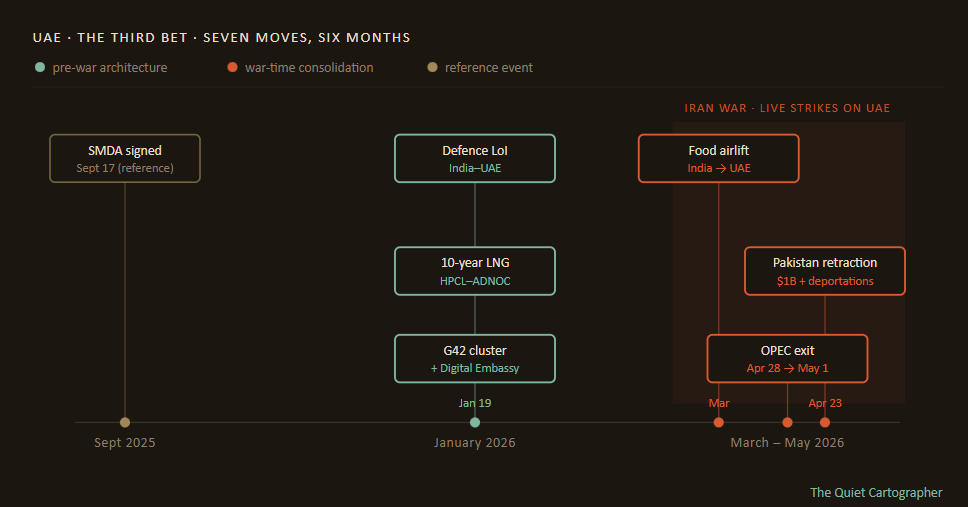
Energy and the OPEC exit. On April 28, the UAE announced its withdrawal from OPEC and OPEC+, effective May 1. The decision freed the UAE from a 3.2 million barrel-per-day quota at a moment when its production capacity stood at 4.8 million bpd — roughly 1.6 million bpd of strategic flexibility, available immediately for bilateral arrangements outside the cartel. India is the natural absorber. The deeper logic is forward-looking: UAE and India both treat the future as belonging to clean energy. UAE’s Masdar is one of the largest renewable-energy operators in the world; the Mohammed bin Rashid Al Maktoum Solar Park is the largest single-site solar facility on the planet; Barakah Nuclear supplies a quarter of UAE electricity. India has 200 GW of installed renewable capacity and a stated target of 500 GW by 2030. The current US administration is moving away from clean energy. China and India are doubling down. Exiting OPEC lets the UAE position oil as bridge revenue while building the partnerships that matter for the destination — and India, on this dimension, is the largest demand-side partner available.
The HPCL-ADNOC LNG agreement. Signed during MBZ’s January 19 visit to New Delhi: 0.5 million tonnes per year of liquefied natural gas, beginning in 2028, on a ten-year contract. Concrete, multi-year, anchored before the OPEC exit was public.
The Strategic Defence Partnership. Also signed on January 19: a Letter of Intent covering “defence industrial collaboration, defence innovation and advanced technology, training, education and doctrine, special operations and interoperability, cyber space, counter-terrorism.” This is the most significant defence step the UAE has taken with any partner outside its Western patron relationships. It comes weeks after Saudi Arabia formalized the Strategic Mutual Defence Agreement with Pakistan in September 2025, which embedded Pakistani fighter jets and personnel at King Abdulaziz Air Base. The UAE’s choice of India as its strategic defence partner is also a structural counter-move.
The supercomputing cluster. G42, the UAE’s AI champion, agreed to establish a supercomputing cluster in India during the same January visit. First shipments of advanced US-export-licensed chips from Nvidia, AMD, and Cerebras were announced for arrival within months. Digital Embassy concepts are being explored — sovereign-arrangement digital presence in each other’s territories, an architecture that doesn’t yet exist anywhere else.
The reverse-direction lifeline. When the Strait of Hormuz closed in March, 70 percent of GCC food imports were disrupted. The UAE airlifted 12,000 fresh food packages from India inside the first week of the blockade. The partnership had been signed in commercial documents. It was tested in operational conditions, and it worked.
The humanitarian-soft-power layer. During the same conflict, India sent two contingents of medical aid to Iran. India was sustaining non-aligned humanitarian relationships across both sides of a regional conflict — supplying Iran while supplying the UAE, while remaining publicly neutral, while continuing to absorb Pakistani fuel-price spillovers from Hormuz disruption without retaliating on the diplomatic side. The UAE noticed. A partner who can hold neutrality across a hot war while still delivering to its allies is a different category of partner from one whose alignment is conditional.
Capital and platform architecture. UAE sovereign wealth into NIIF II (the National Investment and Infrastructure Fund’s second vehicle), DP World and First Abu Dhabi Bank branches in GIFT City, the Dholera Special Investment Region. The structure is reciprocal: UAE capital flowing into Indian infrastructure, Indian talent flowing into UAE platforms, both compounding through the Local Currency Settlement system that bypasses dollar intermediation.
None of these moves is individually unprecedented. The simultaneity is. Seven domains, six months, one direction.
The Pakistan subtraction
The flip side of an addition is a subtraction. The UAE has been deepening with India and retracting from Pakistan inside the same six-week window, and the two are one strategic move, not two.
On April 23, the Abu Dhabi Fund for Development demanded immediate repayment of $1 billion from Pakistan against a total $3.45 billion debt — an arrangement that had been managed with deliberate patience for years. From mid-April onward, an estimated 15,000 Pakistani Shia workers have been deported, decades of residency unwound in days. Etihad Airways terminated 15 Pakistani employees with a 48-hour exit notice. The phrase one analyst used captures the move: Pakistan has been reclassified, in UAE strategic terms, from partner to credit risk. The military signal had been delivered earlier, when Pakistan’s mediation in the Iran war was read in Abu Dhabi as alignment with Riyadh, Tehran’s negotiation track, and Cairo — without securing the UAE’s security interest.
Crucially, Pakistan provides the UAE with no benefit the UAE cannot now source elsewhere. Workforce, other states supply at scale and at higher productivity. Strategic depth, the SMDA delivered to Saudi Arabia rather than to the UAE. Diplomatic utility, Pakistan’s Iran mediation directly cut against UAE interests. The retrenchment was rational, comprehensive, and timed to coincide with the India deepening — because both moves are expressions of the same strategic logic.
The architecture being recognised
The UAE’s third bet is not being made in isolation. It is being made into an architecture that is forming visibly across the broader region.
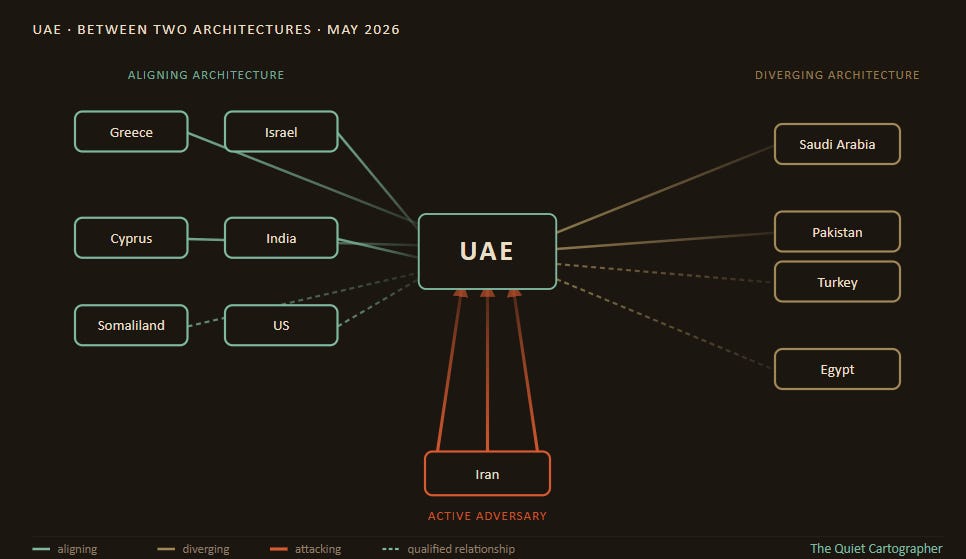
In late December 2025, Israel, Greece, and Cyprus signed a 2026 trilateral military cooperation plan, including joint exercises and a discussed rapid-response force concept. India was formally invited to the “3+1” framework. On December 26, Israel recognized the Republic of Somaliland — the first state to do so — and Foreign Minister Sa’ar made an official visit to Hargeisa in January. The UAE’s existing administrative recognition of Somaliland passports (in place since 2018) became newly visible as alignment when the UAE simultaneously banned Somali passport holders from its visa system in 2026 and stayed silent during the European Union and Muslim-state condemnation of Israel’s recognition decision. There is no formal UAE declaration. The behaviour is the declaration.
On February 22, on the eve of Modi’s state visit to Israel, Netanyahu publicly proposed what he called a “hexagon of alliances” — Israel, India, Greece, Cyprus, and “other unnamed Arab, African, and Asian states.” No government, including India and the UAE, has officially endorsed it. But the architecture being named is the architecture being built. I2U2 (India, Israel, UAE, US) was operationalized in 2022. The India-Middle East-Europe Economic Corridor was announced in 2023. The Cyprus-Greece-Israel trilateral was formalized in 2025. The UAE-India Strategic Defence Partnership was signed in January 2026. Israel did not invent the hexagon by speech. It named what was already taking shape.
The opposing architecture is also forming. The Saudi-Pakistan SMDA, signed September 2025. Turkey reportedly in accession talks with both Riyadh and Islamabad through early 2026. Egypt aligning. Israel publicly characterizing Turkey as “the next Iran.” US Director of National Intelligence Tulsi Gabbard’s March 18 Annual Threat Assessment listing Pakistan among the states whose missile capabilities could one day reach the US homeland. Two architectures, opposed in geography and in posture, forming on roughly the same timeline. The UAE sits squarely between them — structurally aligned with the first, geographically vulnerable to the second, and within Iran’s missile range from across the Strait. That is what makes it a logical target for both Iran and Saudi Arabia, for different reasons, and what makes its third bet existentially urgent rather than merely strategic.
What May 15 tests
A three-hour stopover does not produce a state visit’s worth of formalized agreements. What it does produce, between leaders with a working relationship, is the operationalization of what has already been signed in principle.
The likely deliverables, in approximate descending order of probability: a post-OPEC bilateral energy security framework formalizing what the OPEC exit makes possible; defence cooperation deepening, with the January Letter of Intent moving toward executable agreements on training, special operations, and industrial collaboration; reaffirmation of the $200 billion bilateral trade target; further commitments on UAE sovereign wealth flows into Indian infrastructure (NIIF II, Dholera, possibly new vehicles); operational milestones on the G42 cluster and the Digital Embassy concept; and a likely public reiteration of the partnership’s strategic character, in language that will be parsed in Riyadh, Tehran, and Islamabad.
The three- to five-year horizon is where the more speculative possibility sits. The Strategic Defence Partnership LoI explicitly covers “training, education and doctrine, special operations and interoperability.” Those are the doctrinal categories under which an Indian military presence in the UAE — beginning, plausibly, with private-contractor advisory work, training rotations, or facility access agreements — could evolve. This is hypothesis, not assertion. It is not imminent. But the question is now plausibly on the long-horizon table in a way it was not before. If it happens, it will be the deepest single signal of the third bet.
The hexagon question is also worth watching. Whether or not India endorses Netanyahu’s framing, the architecture continues to take shape through bilateral and minilateral channels that don’t require formal endorsement. Watch the next India-Greece-Cyprus engagement; watch I2U2 reactivation under the Trump second term; watch how the UAE positions itself between IMEC and any post-Iran-war Gulf reconstruction architecture.
What will not happen on May 15 is a public realignment announcement. The UAE doesn’t operate that way, and India doesn’t either. What will happen is that two governments who have been moving in the same direction for years will spend three hours converting principle into schedule.
The lesson, restated
The Years of Hunger taught the UAE that single-source dependence is annihilation, not setback. The Iran war taught it that even an eighty-year security relationship will deliver missiles to your territory and a ceasefire negotiated without you. The current US administration’s pivot away from clean energy taught it that even your strongest partner’s strategic direction can diverge from your own. Three lessons. One conclusion.
A state that has been destitute once, in living institutional memory, and bombarded once, in the past sixty days, builds insurance differently than a state that hasn’t. The UAE is not making seven separate bets on India. It is making one bet on the only architecture that, on the available evidence, has the demographic depth, the energy demand, the technology base, the capital alignment, the operational reliability, and the strategic posture to be the destination of the third diversification.
Pearls were the first bet. Oil was the second. India is the architecture of the third — and on May 15, in a three-hour window between two leaders who already trust each other, more of that architecture will quietly be made real.
Follow on X: The Quiet Cartographer
References
Al Jazeera — What’s Netanyahu’s planned ‘hexagon’ alliance
Al Manassa — No, the UAE didn’t ‘just recognize’ Somaliland. What the passport story actually shows
Atlantic Council — ‘They have been exposed’: The Iran war upends Gulf states
Atlantic Council — What I told Israeli lawmakers about reviving regional integration (Daniel B. Shapiro)
CNBC — United Arab Emirates to leave OPEC May 1
Critical Threats Project (ISW) — Iran Update Evening Special Report: May 5, 2026
Foreign Policy / David Ignatius — The Saudi Arabia-UAE Feud Threatens Mideast Stability
Jerusalem Post — Israel, Greece, Cyprus sign 2026 trilateral military plan
Jerusalem Post — Why Saudi crown prince MBS will never join Abraham Accords
Observer Diplomat — Saudi Crown Prince Rejects Abraham Accords
Organiser — UAE Deports 15,000 Pakistanis
Qatar Digital Library — Twilight of Pearl Trade Sees ‘Slave’ Divers Seek Freedoms
PM India — Joint Statement of MBZ visit, 19 January 2026
Security Council Report — Middle East Crisis: Closed Consultations
The National (UAE) — UAE says Iran has no right to use its defence agreements to justify threats
Times of Israel — India, UAE deepen tech ties during MBZ visit
UNESCO World Heritage — Pearling, Testimony of an Island Economy
UAE History and Culture — The Great Pearl Crash of the 1930s
The Emerging Era of the Transitioning!