
Pakistan: A System Under Converging Pressure
Part 1 of 2. The vectors are mapped here. In three weeks — Part 2 tests whether the map held.
On April 15, the State Bank of Pakistan received a two-billion-dollar deposit from Saudi Arabia. On April 20, Islamabad put a $1.5 billion weapons sale to Sudan on hold, at Riyadh’s request. On April 22, Modi marked the first anniversary of the Pahalgam attack with a pledge that India “will never bow to any form of terror”; the Indian Army posted, the same day, that the response to acts against India is “assured.” On April 23, Pakistan seeks to complete the repayment of $3.5 billion to the UAE, a loan Abu Dhabi had refused to roll over at any useful tenor.
The instinct is to read each on its own terms — a balance-of-payments patch, a cancelled export, a commemorative anniversary, a debt obligation honoured. That reading is available, and it is incomplete. The moves are not independent. They are the visible surface of a state whose financing, security, diplomatic, and narrative alignments have begun moving on the same clock. What has happened is subtler: its pressure systems have stopped running on independent schedules.
The window
Between late February and late April 2026, eleven signals — conservatively counted:
February 24. Saifullah Kasuri, LeT deputy chief and accused planner of the April 2025 Pahalgam attack, releases a video: Pakistan had “dominated the air” in 2025 and would “dominate the sea” in 2026. Indian intelligence catalogues it as a 26/11-pattern maritime threat.
February 27. Pakistan strikes Taliban positions in Kabul, Kandahar, and Paktia — the first direct Pakistani strikes on the Afghan Taliban rather than on militants it accuses them of sheltering. Pakistan’s defence minister calls it “open war.”
March 1. US Marine Security Guards and local security forces open fire on protesters attempting to storm the US Consulate in Karachi. At least ten are killed. The protests followed the killing of Ayatollah Khamenei in joint US-Israeli strikes begun February 28. Twenty-three Pakistanis are killed in demonstrations nationwide within a week. A UN office is burned in Skardu. Curfew in Gilgit-Baltistan.
March 18. US Director of National Intelligence Tulsi Gabbard presents the 2026 Annual Threat Assessment. Pakistan is categorised alongside Russia, China, North Korea, and Iran as a state whose missile capabilities could eventually reach the US homeland. Pakistani deterrence specialists note the deterrence is India-specific. The categorisation stands.
March 19. Army Chief Asim Munir tells Shia clerics at a Rawalpindi iftar that those who “love Iran so much” should go there. Shia leaders accuse him of acting at the behest of the US and Israel. The community is 15–20 percent of a population of 250 million.
March 22–23. Munir speaks directly to Trump. Pakistan offers Islamabad as venue for US-Iran talks. The ceasefire that follows is publicly credited by both Trump and Iran’s foreign minister to Sharif and Munir. Pakistan’s most significant diplomatic win in years.
April 3. Petrol rises to PKR 458.40 per litre, diesel to PKR 520.35 — a 40 percent monthly jump driven by Hormuz shipping disruption. Protests follow.
April 9. During the Islamabad talks, Defence Minister Khawaja Asif posts on X that Israel is a “cancerous state” and that its founders should “burn in hell.” He deletes it. Israel’s Prime Minister’s Office calls the post “outrageous” and declares Pakistan disqualified as a mediator. The delegations continue talking.
April 11–16. Saudi Arabia and Qatar pledge a combined $5 billion. Saudi adds $3 billion during the IMF Spring Meetings. The first $2 billion tranche lands in the State Bank on April 15.
April 12. BLA ambushes a Pakistan Coast Guard patrol near the Iran border. Three dead. First militant attack on Pakistan’s maritime authority in the Arabian Sea. The BLA calls it a new phase.
April 20–23. Sudan deal frozen. Pahalgam anniversary marked with warning language from New Delhi. Iranian state-linked media (SNN) publicly cast doubt on the Islamabad mediation channel, an analyst saying Munir “will go back and sit in Islamabad” whether or not a response ever arrives. Trump extends the US-Iran ceasefire, citing a direct “request” from Pakistan’s leadership and a “seriously fractured” Iranian government. UAE repayment nears completion. Roughly 13,000 Pakistani troops operate at King Abdulaziz Air Base under the Strategic Mutual Defence Agreement signed in Riyadh the previous September.
Each event has its own file. Read in series: a state whose external financing, security architecture, sectarian management, diplomatic positioning, frontier violence, and narrative cycles are no longer negotiated separately with different counterparties.
The external alignment, and what it costs
The financial layer is the one that shows first, because it runs on ledgers.
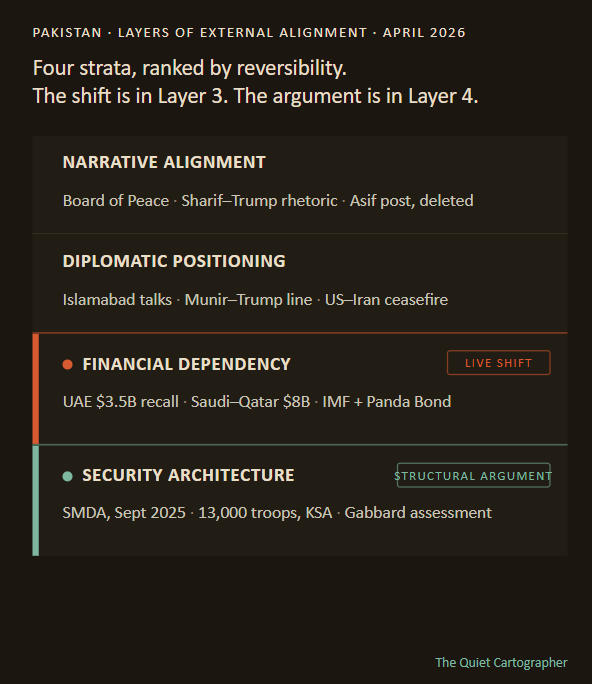
The UAE refused rollover at workable terms. Saudi Arabia and Qatar extended $5 billion, then Saudi added $3 billion — collectively more than Pakistan needed to settle the UAE bill. This is not bilateral creditors pricing risk. It is a bloc consolidating a member, operating under the Strategic Mutual Defence Agreement signed at Al-Yamamah Palace in September 2025: aggression against one is aggression against both.
The SMDA is not dormant. Pakistani troops are now stationed at Saudi air bases; Pakistani aircraft have followed. The Sudan deal was not frozen on commercial grounds — Saudi Arabia withdrew the financing, and the deal died because Islamabad’s defence export policy is no longer separable from Saudi regional strategy. When the capital that funds your reserves is also the capital to which you owe mutual-defence obligations and at whose air bases your forces operate, the word “alignment” understates what is happening. Pakistan’s options on the Iran file, the Israel file, the Sudan file, and the US file all now route through Riyadh.
They also route through Washington, via Riyadh. Pakistan signed the Board of Peace in January. Sharif called Trump the “saviour of South Asia.” Munir’s direct line to Trump produced the ceasefire that remains Pakistan’s most valuable diplomatic asset. Islamabad can disagree with Washington, in theory. In practice, its financing pipe and its security guarantor both run through a third capital that Washington trusts more than it trusts Islamabad.
What the constraint cannot produce is coherence between the state’s older identity and its newer one. Pakistan hosted the Islamabad talks while police were still clearing curfew in Gilgit-Baltistan from the Khamenei protests. Pakistan’s defence minister called Israel a “cancerous state” on April 9 — while the US and Iranian delegations his government was brokering between were physically in Islamabad. The contradiction is not a communications failure. It is the older identity still on the letterhead, the newer one running the ledger, and the ministers still speaking from the older identity while the state itself operates from the newer one.
The mediator role does not survive two counterparties who both, within two weeks, publicly question it. Israel called Pakistan "disqualified" as a mediator on April 9 over the Asif post. Iranian state-linked media on April 22 cast doubt on whether the Islamabad channel produces anything at all. Pakistan's diplomatic win is now being audited, in public, by both sides of the war it brokered a ceasefire for. The ceasefire still holds. Trump cited a Pakistani "request" as one reason he extended it. But the mediator position and the assessment of the mediator position are now on separate clocks — which is the same synchronisation problem the rest of this piece is about.
Four frontiers on one clock
Pakistan has four active frontiers. They are not one conflict. They are four insurgencies or tensions with different ideologies, geographies, and timelines — but they are now escalating together.
On the southwestern frontier, the BLA launched “Operation Herof 2.0” in late January — coordinated assaults across nine districts, 48 civilians killed, 145 BLA fighters killed in the counter-operation. By April 12, the campaign extended to water: the Coast Guard ambush near the Iran border opened the maritime phase.
On the north-western frontier, the TTP surge through late 2025 provoked Pakistan’s February 27 strikes inside Afghanistan — the first time Islamabad hit Taliban positions directly rather than TTP sanctuaries. Militancy leaked beyond the tribal belt: the November 2025 Islamabad suicide bombing was the capital’s first in a decade. The US Institute of Peace and ACLED had both flagged, months earlier, that 2025 was on track to be one of Pakistan’s most violent years in over a decade.
On the eastern line, the Kasuri “dominate the sea” video landed February 24 — pointing at India, pointing maritime. Two months later, April 22, the Pahalgam anniversary arrived with Modi’s warning and the Indian Army’s public promise that the response to acts against India is “assured.” Operation Sindoor’s anniversary was marked on the same calendar.
And the Iran frontier — a relatively quieter 900-kilometre border — is now the edge of a war zone. The BLA maritime ambush of April 12 is not just an attack on Pakistani patrol vessels. It is an attack at the edge of Iranian Sistan-Baluchistan, by Baloch factions whose constituency exists on both sides.
These are not one story. The BLA is a secular ethno-nationalist insurgency concerned with resource extraction and political marginalisation. The TTP is a religious militancy with sanctuary across an international border. LeT is a state-adjacent Pakistani group whose target is India. India itself is a conventional state actor with a conventional deterrence posture and a Pahalgam clock ticking on its calendar. They operate in different provinces, under different ideologies, on different timelines.
What these fronts share is not cause. It is the state’s attention budget, which is finite. Every soldier at King Abdulaziz Air Base is a soldier not in Quetta. Every rupee routed through the UAE settlement is a rupee not available for a coast guard that might have patrolled south of Jiwani. The BLA, the TTP, and LeT moved into space the state was vacating — and each of them signalled into maritime space within a two-month window, from opposite coasts, against two different states.
Internal fragility, externally sourced
The internal layer is where external alignment becomes binding.
Consider the April 3 fuel shock. A 40 percent monthly jump in petrol prices is not a domestic policy choice. It is Hormuz disruption arriving at the pump — and it arrived while foreign reserves were being held for the UAE deadline. Islamabad could not smooth the shock because it could not redirect the reserves. Inflation, in this configuration, is not a variable the central bank can unwind. It is external exposure metastasising inward.
Consider the response to the Khamenei protests. Marines firing at a consulate crowd, a three-day Gilgit-Baltistan curfew, an Army Chief telling Shia clerics to emigrate if their loyalties are unclear — this is not a state calibrating sectarian management on its own timeline. It is a state choosing suppression over dialogue because dialogue takes time the alignment has not budgeted.
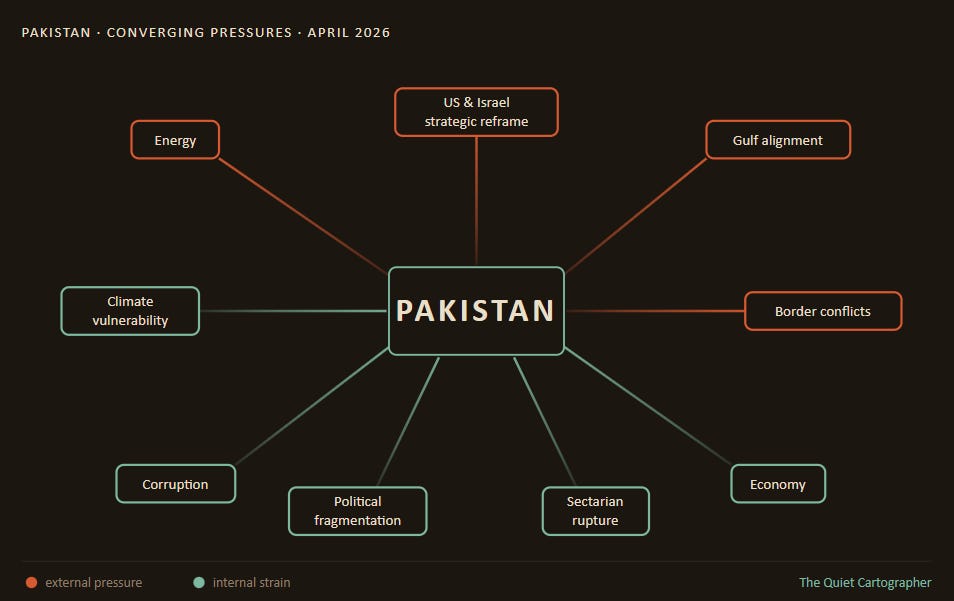
The pattern generalises. Pakistan’s inflation, energy dependency, governance rating, and climate exposure are each hard problems. None is novel. What is novel is that the external alignment has removed the slack the system used to have to address them. Fuel prices cannot be smoothed because reserves cannot be redirected. Sectarian unrest cannot be de-escalated slowly because the alignment requires visible discipline. Political consolidation cannot wait because creditors will not.
The internal pressures did not cause the alignment. The alignment made the internal pressures load-bearing.
Convergence without resolution
The distinction this piece depends on: a crisis is an event, synchronisation is a condition.
Crises have a before and an after. Synchronisation is the phase in which a state’s pressure systems stop running on independent clocks. In Pakistan right now, each vector transmits pressure to the others through specific channels: the UAE deadline drew down reserves that the Saudi deposit was timed to replace; the Saudi financial rescue was conditioned on a Sudan deal reversal; the Sudan reversal redefined Pakistan’s defence export policy; the Iran war drove the fuel shock that destabilised the domestic base at exactly the moment foreign reserves were committed elsewhere; the Khamenei killing produced street violence that demanded suppression Pakistan could not afford to de-escalate slowly; the Pahalgam anniversary arrived with LeT maritime rhetoric that now sits in the same ocean the BLA just opened.
Pakistan with its current institutional depth and its demonstrated diplomatic capability has many directions to move; the most likely near-term direction is exactly what Islamabad has been doing — patch, settle, deploy, suppress, repeat.
The Islamabad ceasefire was not an accident. It was the kind of move a state pulls off when it is genuinely useful to everyone involved, and Pakistan made itself genuinely useful in a three-day window.
But capability inside synchronised pressure is different from capability inside independent pressures. The second is statecraft. The first is statecraft on a narrowing runway. The question is not whether Pakistan can manage any one file. It is whether the files can still be managed separately.
What to watch
Part 2, on May 15, closes the loop on seven questions. None of the answers is knowable from here. All will matter by mid-May.
The Saudi bind. Does the $8 billion package stabilise reserves through June as Islamabad projects, or does it generate conditions — on posture, deployments, the Iran file — that alter Pakistan’s stated neutrality? Watch the next Pakistani move on Iran; watch whether forces at King Abdulaziz grow, shrink, or rotate.
The US frame. Does the Gabbard characterisation develop into policy — export controls, CENTCOM posture changes, sanctions review — or does it remain rhetorical? The answer tells us which version of the US-Pakistan relationship Washington is actually operating in.
The mediator role. Does Pakistan retain its position as brokering channel between the US and Iran? Does the second round of Islamabad talks happen? Does either counterparty escalate its critique — or does Islamabad pull off a second usable outcome that silences the current scepticism?
The western frontier. Does the Afghan confrontation de-escalate under Chinese mediation, or does “open war” harden? Does the BLA’s maritime phase continue?
The eastern line. Does the post-Pahalgam narrative cycle stay rhetorical, or does the Kasuri threat turn operational — or get used as pretext by either side for escalation? Watch the Line of Control; watch the maritime space between Karachi and Gujarat.
The sectarian rift. Does Munir’s position toward the Shia clergy soften, or calcify?
The economic floor. Does the fuel shock reverse or settle as structural? Does the IMF disburse on schedule? Does the Panda Bond issuance clear — genuine currency diversification, or a symbolic gesture?
The synchronisation thesis does not require that each vector resolve in the same direction. It requires only that the clocks begin to decouple.
If they do, the map was provisional and the system has slack.
If they don’t, the map is a floor, and Part 2 is a different article.
Follow on X: The Quiet Cartographer
References
Climate Risk Index (Germanwatch)
Institute for Economics and Peace (Global Terrorism Index)
U.S. Department of Defense Briefings
Great piece! The way you tie these various events together is very compelling. Between the signing of the mutual defense agreement in 2025 and the mediator role being played now, Pakistan has made itself a player in a somewhat stealthy way. I honestly didn't think we would be hearing and writing this much about Pakistan when the bombs started dropping on February 28th.